
The Hidden Value of Data: Useful or Useless?

1–2 minutes

Content is fascinating. It fuels computation and defines what users see and use. But its value changes with the user: the same content can be vital for one and useless for another, no matter how expertly crafted or beautifully presented.

Same Content, Multiple Types

Take a document prepared for different users. Each person sees it differently, shaped by their own needs. That same document can be turned into new versions, some that fit a user’s requirements and others that don’t.
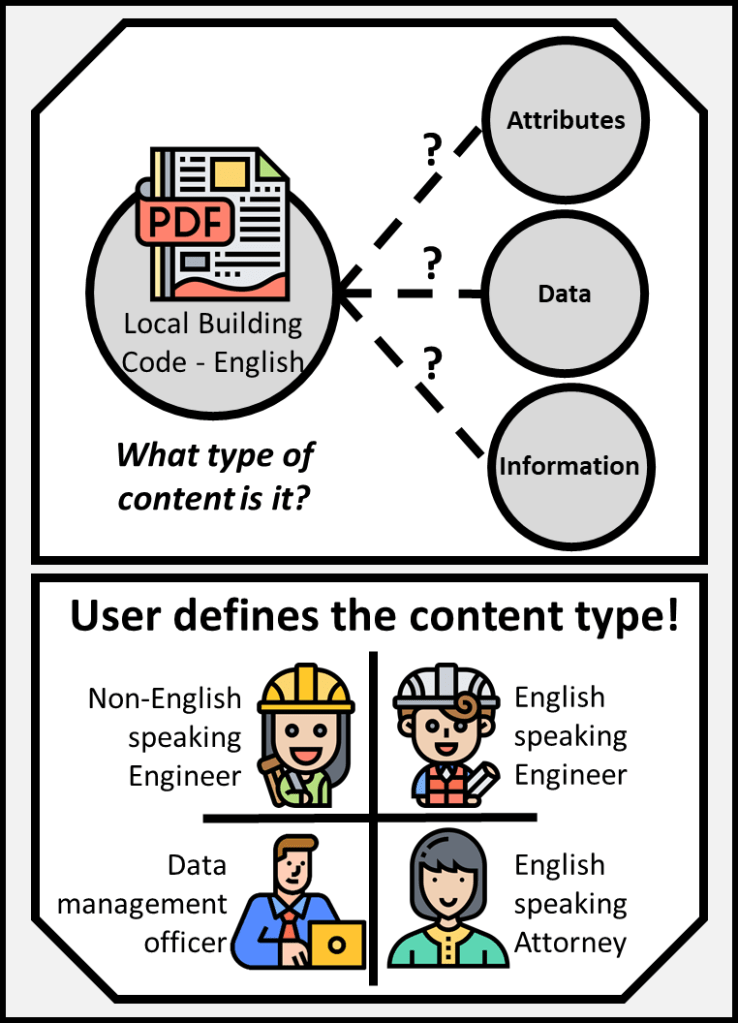
A pdf document titled "Local building code - English" is content, but what type is it? Attributes, data, or information? User defines the type of content. We have four types of users each of which will give this document a different type.

A non-English-speaking engineer can use the document only after a skilled translation lets them find the information they need.
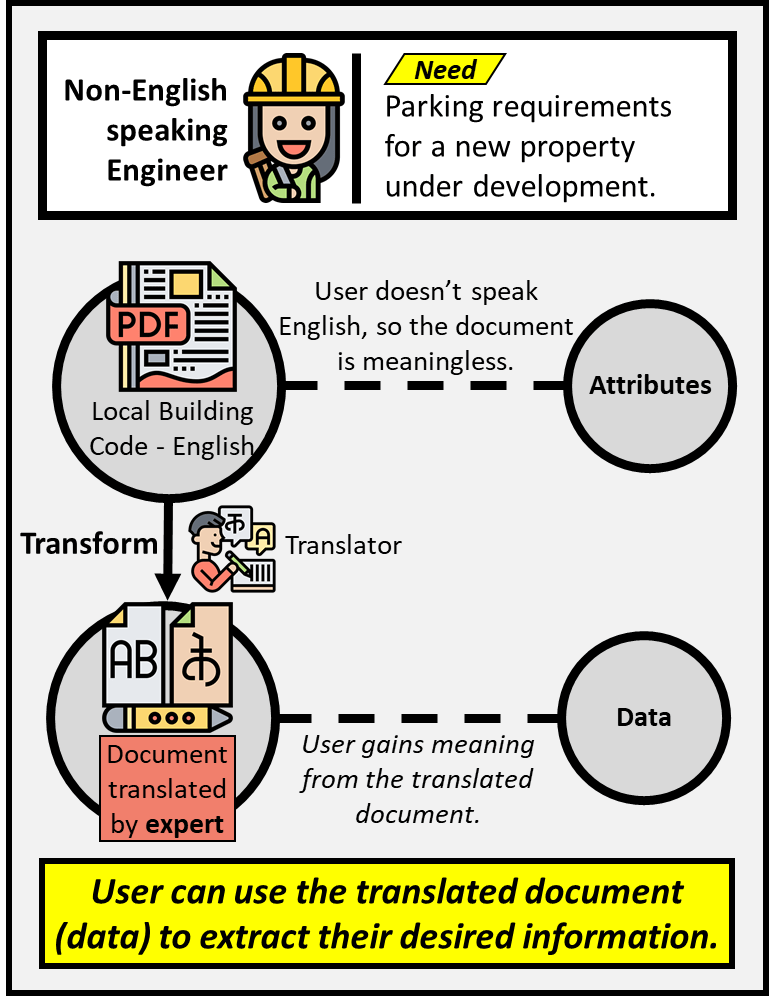
A non-English speaking engineer needs this document to find parking requirements for a new property under development. The user doesn't speak English so the initial document is meaningless and considered attributes. If transformed by an expert translator it can be used by the user, has meaning and is considered data.

The data officer only needs the document uploaded in the required format, with no further use for its content.

A data management officer needs this document published on the agency's official website. As-is the document is in the correct format and serves its purpose for the user and is considered information. If it is transformed into another format by a machine, while valid and usable it does not satisfy the user's requirements and is considered data.

The English-speaking engineer can use the document immediately and seeks an expert’s help to turn it into the needed information.
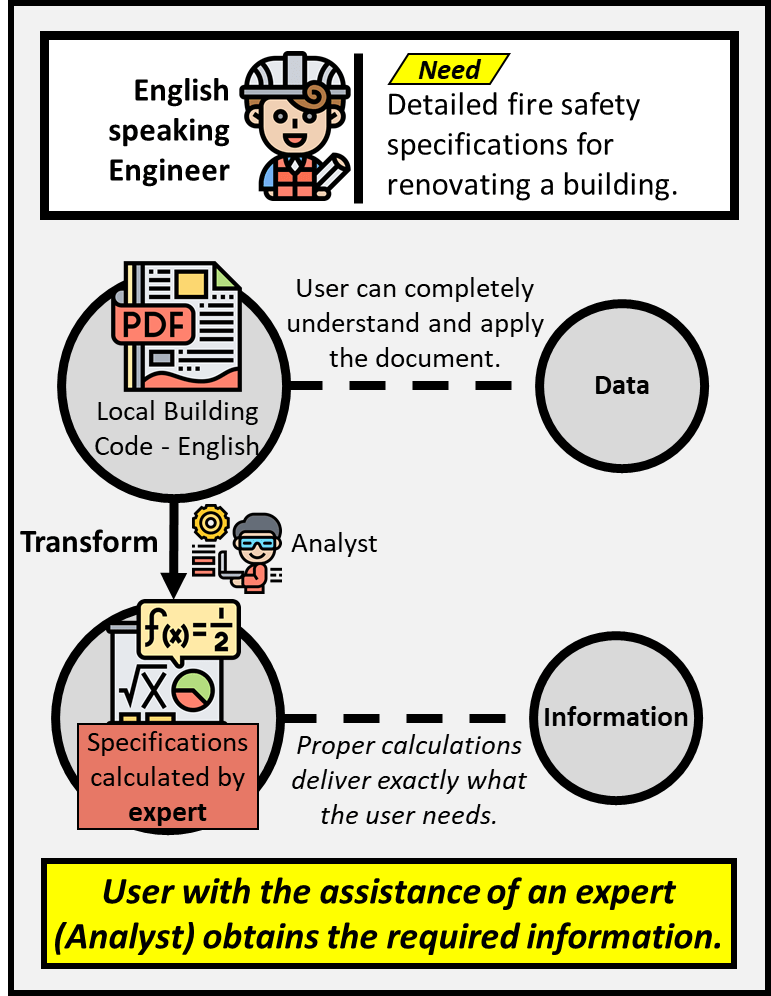
An English-speaking engineer needs detailed fire safety specifications for renovating a building. The initial document can be fully used by the user and is considered data. It can by transformed by an expert analyst to specify the exact calculations needed by the user and therefore becomes information.

The English-speaking attorney can read the document, but even with expert transformation, it fails to cover their remaining requirements.
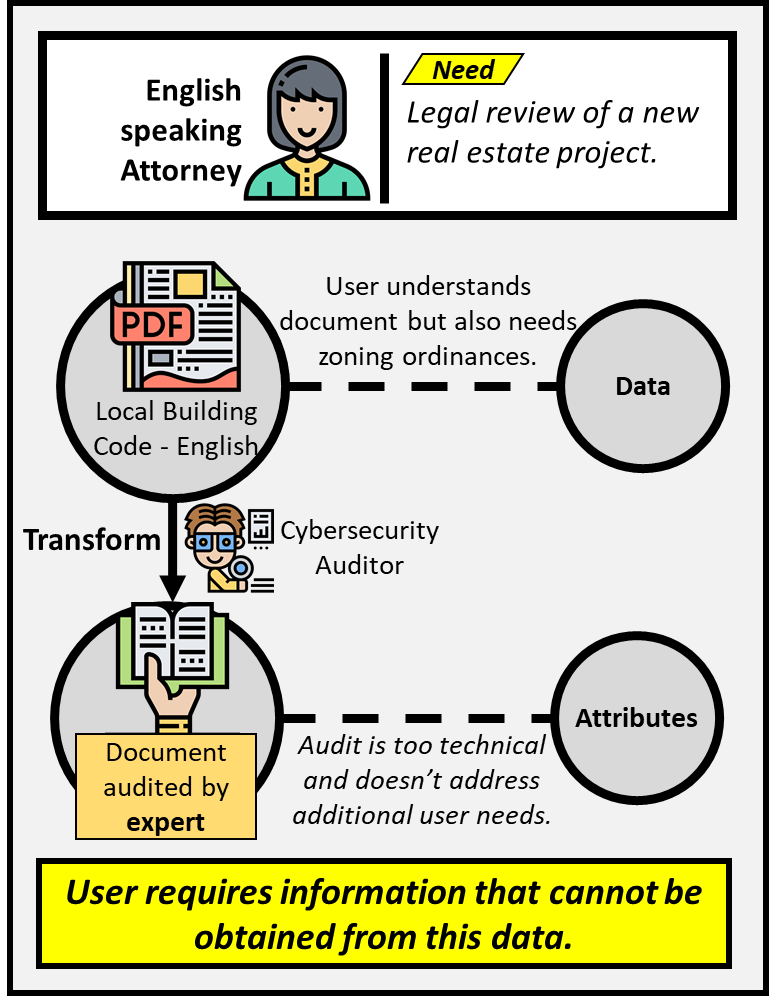
English speaking attorney needs the document to perform a legal review of a new real estate project. The user can understand the document and is therefore classified as data but they also have additional requirements not covered by the document. An expert transformation by a cybersecurity auditor will result in a technical audit that cannot be understood by the user nor does it cover their additional requirements therefore it is considered attributes.

Content Properties

Content has three key properties that guide its description and transformation. The challenge is figuring out how to use them effectively to solve the complex problems individuals and businesses deal with daily.
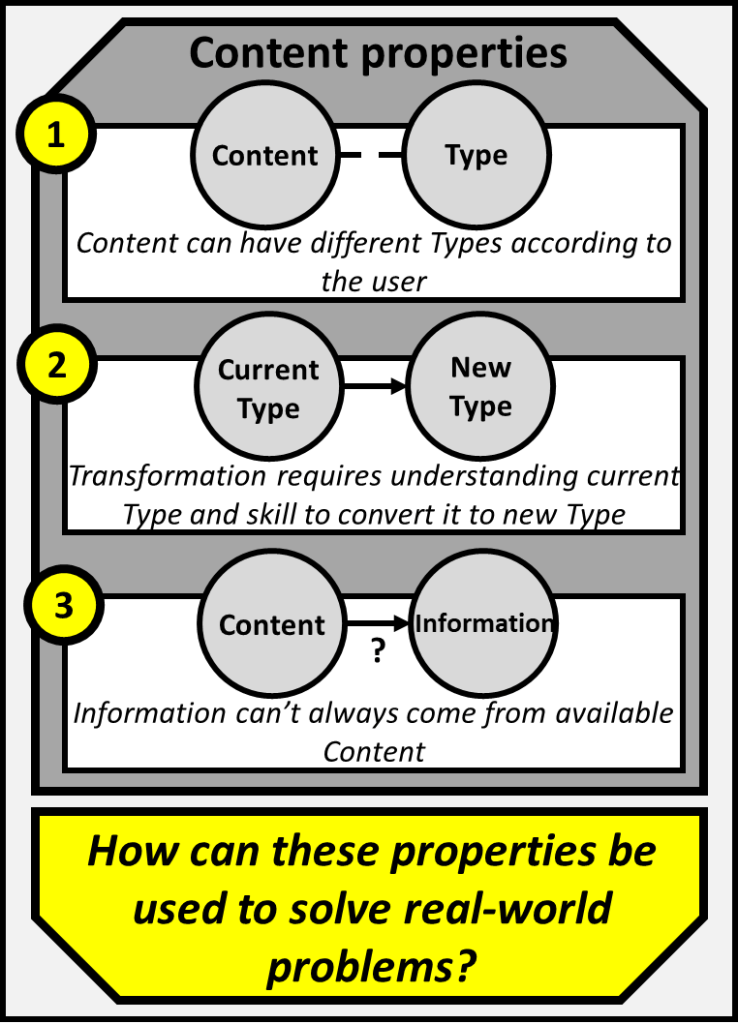
1. All content has a type that ius defined according to the user of the content.
2. Conversion of type requires understanding the current type and skill to convert it to the new type.
3. Information can't always come from available content.

Content Transformation and Analytics

Customers, analysts, and machines all shape analytics problems. Here’s how Advanata uses content properties to solve them.
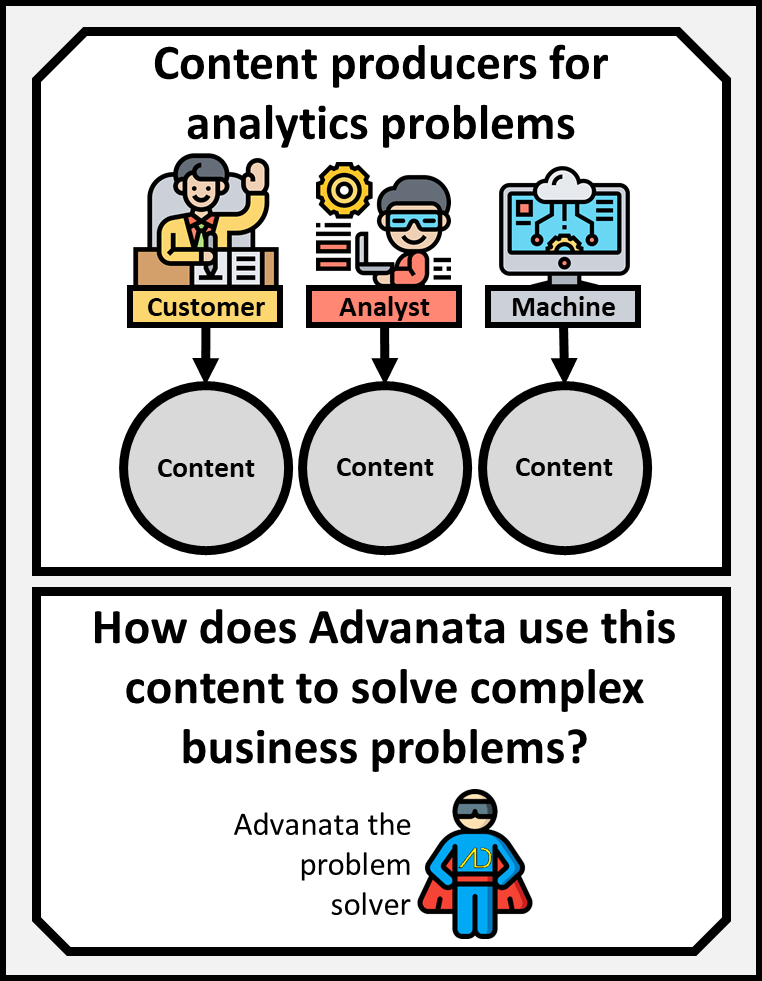
Customers, analysts, and machines produce content for analytics problems. Advanata uses this content to solve complex business problems.

The first step is turning the customer’s expertise into a clear, structured problem.

Advanata needs the exact customer problem to be specified. Customer has knowledge which isn't entirely content and Advanata must distil and structure this expertise. The business problem framework structures this knowledge into a problem structure which is information.

Next, the parameters are defined by breaking the problem into smaller parts.
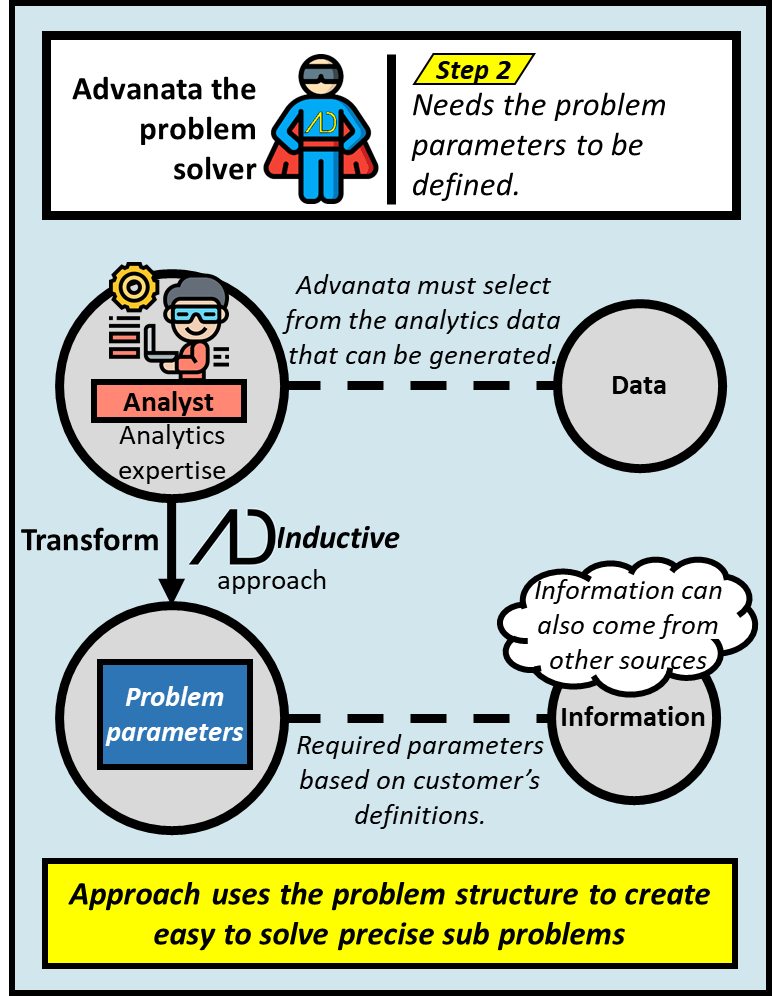
Advanata needs the problem parameters to be defined. Analysts can generate massive amounts of analytics which is considered data. The inductive approach selects from this data what is required for the problem to arrive at problem parameters which is now considered information.

Finally, the optimal solution is found using the customer’s requirements.
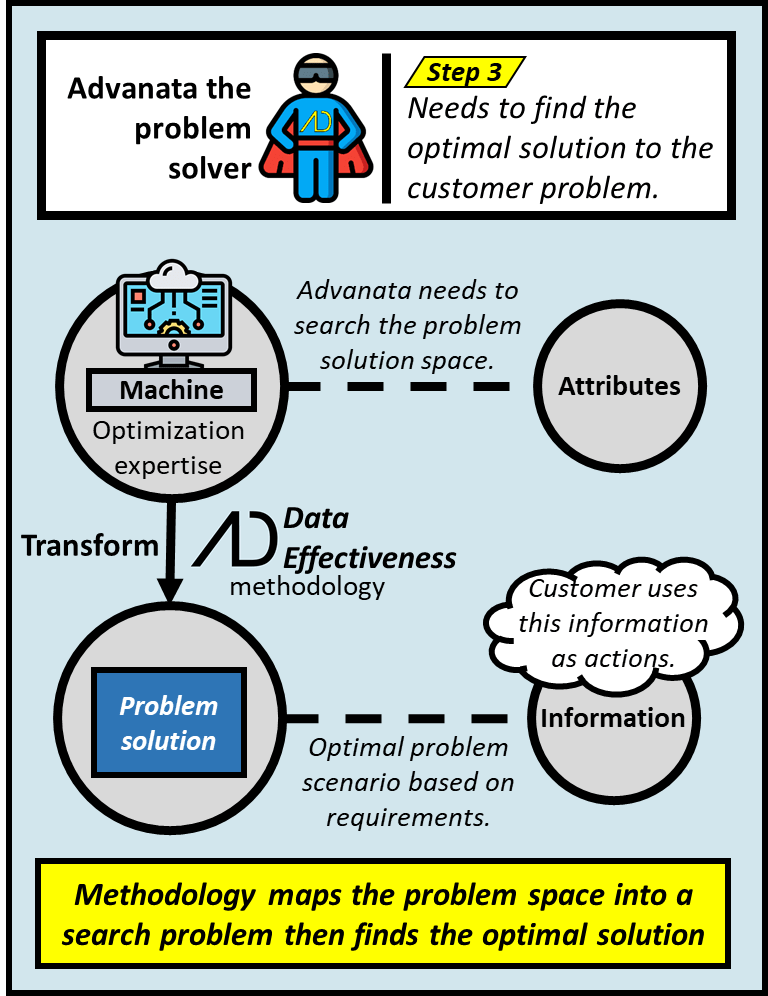
Advanata needs to find the optimal solution the customer problem. Machines can generate the entire solution space which is attributes since they have no observable meaning. The data effectiveness methodology searches this space to arrive at the optimal solution based on the customer's requirements and outputs precise actions.

Content Polymorphism

The same content can have different types depending on its use. Even masterfully prepared content may leave users unsatisfied, demonstrating the importance of a customer-driven analytics approach. True solutions only emerge when problems are clearly defined and guided, which is why an inductive approach powers the core of Advanata’s technology.

Sign up to get the latest articles and product updates.

Ready to see Advanata in action? Explore more resources, read related articles, and access the full application at advanata.com.

Want a personalized walkthrough? Contact info@advanata.com to get application access and schedule a demo.

Leave a comment