
Turn complex business decision problems into optimized operational actions
Advanata is an effectiveness platform that makes decision optimization solutions for complex business decision problems accessible to anyone.
Sign up for early access to articles, delivered every two weeks. Please check your spam folder for the confirmation email.

Empowering all users to optimally solve their business decision problems. Advanata delivers real solutions for real problems. Effortlessly, efficiently, and effectively.
The Analytics Paradox
Traditional analytics often begins with an open-ended search. Data is explored, trends are analyzed, forecasts are refined, and new insights and recommendations are continuously generated in the hope that a solution will eventually emerge. While this process can produce valuable content, it lacks a precisely defined endpoint where even the final task of combining these results into a workable solution is left to the decision-owner.
Advanata starts from the decision-owner’s perspective and reverses this process by organizing the problem around its essential goals, options, and resources, with the solution expressed as a precise set of actions. Analysis then works backward from those actions to determine the information needed to optimize them, ensuring every analytical activity directly supports solving the actual problem.
Traditional analytics searches for solutions. Advanata solves well-defined problems.
What is Advanata?
Advanata is an easy-to-use, decision-owner-driven decision optimization platform that delivers optimized operational actions for complex business decision problems.
What are business decision problems?
Business decision problems are structured operational systems defined from the decision-owner’s perspective and composed of measurable business goals, available operational options, and causal decision structure. These components define how limited resources can be allocated across interconnected operational options that influence desired business goals.
What is a decision structure?
Causal decision structure represents the relationships, dependencies, and allocation pathways through which limiting resources are allocated to operational options that influence business goals.
What are business goals?
Measurable business goals are clearly defined and quantifiable outcomes a business aims to achieve and provide the targets used to evaluate the activation of operational options.
What are operational options?
Available operational options are the potential actions a business can activate that are causally linked to achieving its business goals and are both feasible and acceptable.
What are limiting resources?
Top-level available capacity which can be allocated or transformed into the different resources required to activate options and limits the actions that can be taken.
How is this different from traditional consulting?
Traditional consulting often depends on lengthy analysis, interviews, and external interpretation before problems can be structured. Advanata allows decision-owners to capitalize on the knowledge they already possess and rapidly define business decision problems directly through business goals, operational options, and decision structure.
What are optimized operational actions?
Optimized operational actions are the precise outputs generated through decision optimization to achieve desired business goals.
How is this different from traditional analytics?
Traditional analytics focuses on generating insights and recommendations that still require interpretation and additional decision making. Advanata focuses on delivering optimized operational actions that comprehensively solve business decision problems.
What is decision optimization?
Decision optimization is the process of determining the best operational actions needed to achieve business goals given operational options and decision structure.
What is data effectiveness?
Data effectiveness is the decision optimization methodology used by Advanata to transform business goals, operational options and constraints into optimized operational actions.
What differentiates this from traditional decision support methods?
Advanata is a single cohesive system that converts business decision problems directly into optimized operational actions without requiring user inference to piece together fragmented analyses, or repeated handoffs between experts.
How is this different from traditional optimization approaches?
Traditional optimization approaches often require specialized expertise, technical modeling, and difficult-to-interpret outputs. Advanata makes decision optimization accessible by allowing decision-owners to rapidly build understandable solutions directly around their defined business decision problem.
Sign up for early access to articles, delivered every two weeks. Please check your spam folder for the confirmation email.
How does Advanata work?
Advanata is a decision-owner-driven decision optimization platform that uses data effectiveness to transform business decision problems into optimized operational actions through a simple three-step process within a single system. The entire process is transparent, easy to understand and critique, and can be repeated as needed to explore different scenarios or refine the business decision problem over time.
1. Define the Decision Structure
The process begins by defining the components of the decision from the decision-owner’s perspective: measurable business goals, available operational options, and causal operational structure. For example, a business might define goals such as increasing revenue or maximizing profit margins, operational options such as marketing spend or employee training, and an operational structure that determines how a limited budget can be distributed across those options and how those options contribute toward business goals.
Decision-owners can directly define and refine decision structures themselves for most business decision problems, while more complex cases can involve other subject matter experts helping expand or refine the available operational options.
2. Refine Operational Parameters
The decision structure parameters are refined by estimating how operational options use the available resource and influence business goals. For example, increasing online advertising spend may directly improve profit and revenue, while training resources may first be allocated between certification programs and workflow automation tools which then contribute differently toward profit and revenue.
Even when complete data is unavailable, parameters can still be estimated using operational experience, domain knowledge, or input from subject matter experts. This step can be revisited and improved as better information becomes available.
3. Run Decision Optimization
The system then evaluates the structured decision model and determines precisely how the available resource should be allocated across operational options to best achieve the defined business goals. The output is a clear set of optimized operational actions that can be directly used to guide execution. For example, to maximize short-term revenue, more budget may be allocated toward marketing. To maximize long-term profitability, more resources may instead be allocated toward employee training.
Decision-owners can explore different scenarios by adjusting priorities such as maximizing profit margin, increasing revenue, minimizing costs, or targeting a specific operational outcome.
Example application: Healthcare Marketing Budget Optimization
A medium-sized healthcare provider engaged with Advanata to improve its marketing budget allocation. Using the provider’s existing allocation as a starting point, this application demonstrates how the decision could be optimized and the potential performance improvements that could be achieved using representative industry assumptions.
Challenge
The provider’s marketing team wants to allocate its budget across multiple marketing channels to maximize both revenue and patient acquisition. The organization currently invests across traditional, digital, and direct marketing channels and intends to maintain this overall structure. The team is looking to leverage analytics to better understand channel performance but is uncertain where or how to apply it effectively to inform allocation decisions.
Approach
The marketing team approached the problem by developing sophisticated patient segmentation across nineteen dimensions, prioritizing seven specific personas, analyzing competitor marketing tactics, and evaluating competitive intelligence tools. While this analysis was insightful, the team faced a common challenge: determining which insights to act on and how to translate them into a solution. This represents the traditional open-ended analytics approach, where content is gathered in search of an answer, but the path from analysis to decision remains undefined.
When structured as a business decision problem, Advanata changed the focus from understanding the market to actually solving the problem. Marketing budget is the limited resource, marketing channels are the options, and the desired goals are to maximize both revenue and patients acquired. Because the organization already allocates spending across these channels, the marketing team can independently define the initial decision structure quickly and with minimal effort.
Expected channel performance can be estimated using historical campaign results, team experience, and industry benchmarks. The team can then specify the available budget, select optimization goals, and generate a precise allocation designed to maximize expected performance rather than generating additional insights for interpretation.
Results
The proposed optimized allocation recommends changing the current allocation to increase investment in the highest-performing channels while reducing spending in those with lower expected results. The decision optimization problem can be repeated as new performance information is incorporated or as the business decision problem evolves.
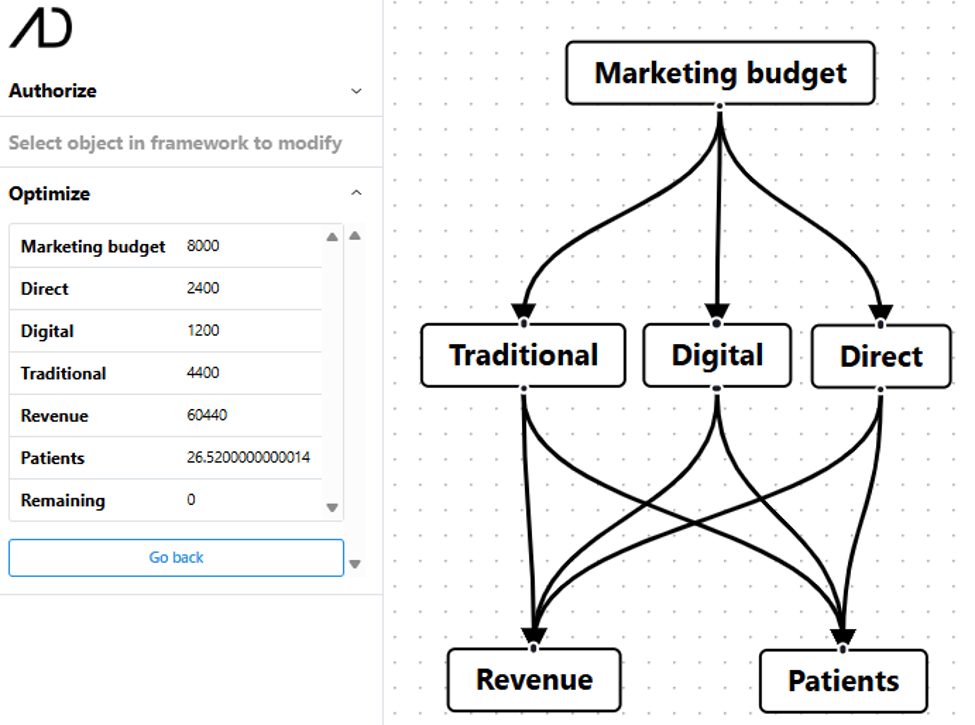
| Channels | Current (USD 000s) | Proposed (USD 000s) | Change |
|---|---|---|---|
| Traditional | 1,600 | 4,400 | +175% |
| Digital | 5,840 | 1,200 | -79% |
| Direct | 560 | 2,400 | +329% |
| Goals (Expected) | Current | Proposed | Change |
|---|---|---|---|
| Revenue (USD 000s) | 33,128 | 60,440 | +82% |
| Patients (000s) | 21.8 | 26.5 | +22% |
Key takeaway
Rather than relying on ad-hoc planning methods, isolated channel analytics that require further interpretation to translate into actions, or high-level expert recommendations that are difficult to incorporate quantitatively, the marketing team can, with just a few simple steps, precisely evaluate all available marketing options and identify the budget allocation most likely to maximize revenue and patient acquisition.
This example uses a high-level channel allocation for illustrative purposes and is intended to demonstrate a simple application of Advanata. In practice, this business decision problem can be refined further by adding new channels, incorporating subchannels, applying allocation constraints, accounting for uncertainty, or targeting alternative business goals.
Sign up for early access to articles, delivered every two weeks. Please check your spam folder for the confirmation email.

How can Advanata be used?
Advanata delivers the optimal operational actions to solve a wide range of business decision problems. The following is a small sample of the potential operational challenges that can be easily solved.
Optimal strategic planning
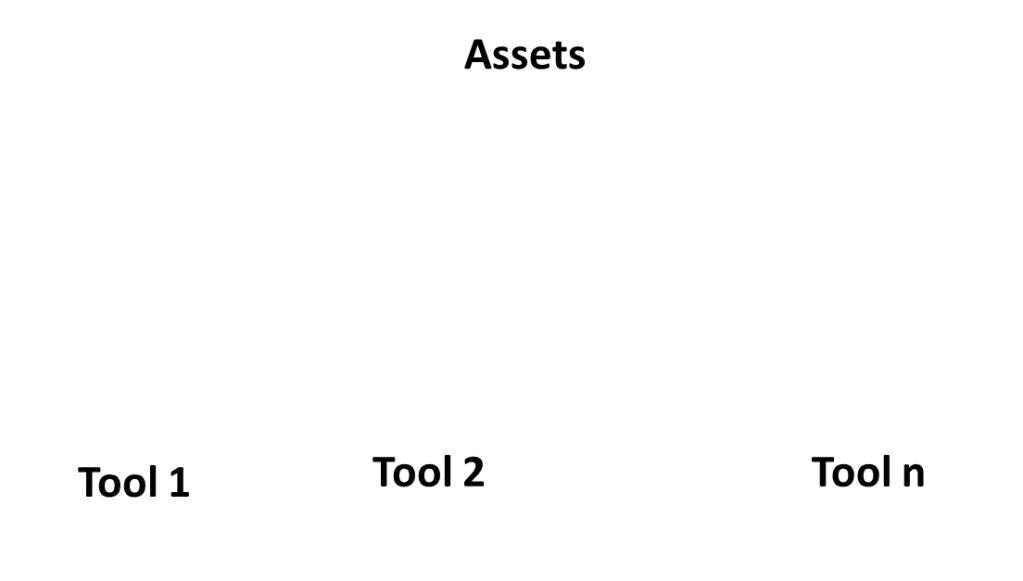
The basic challenge of reaching goals with available tools and with limited assets reflects a wide range of resource optimization challenges decision-owners face daily. The following are some cases:
- A marketing department needs to optimize the allocation of their marketing budget across selected advertising channels.
- A furniture workshop wants to optimally allocate a new investment towards achieving their profit and revenue targets.
- An individual wants to meet their macro and micronutrient requirements while optimizing their caloric intake.
Enhanced design of products and services
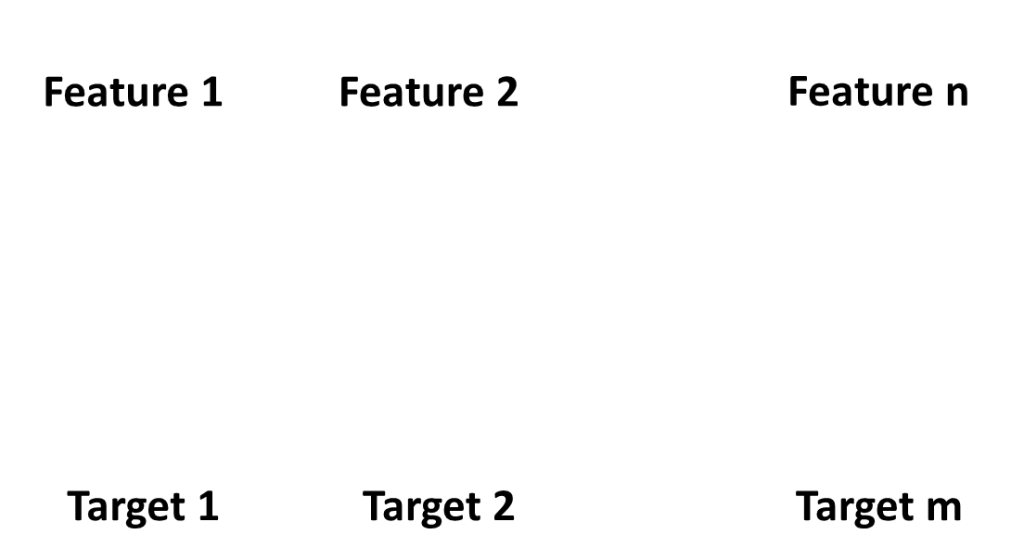
Choosing the optimal set of features for a business’s offerings to achieve its targets is an ongoing challenge. The following are some examples:
- A manufacturer wants to optimally design a new product for specific markets while building on features from its existing lineup.
- An ad agency builds on past campaign elements to craft an optimized advertisement for their desired audience segments.
- A real estate developer aims to attract target demographics to a new project by offering an optimized set of amenities.
Smarter business optimization
Pricing of products and services can be optimized to balance competing needs both within and outside the decision-owner’s business. The following are some scenarios:
- A restaurant aims to increase menu item prices to optimize profits without alienating its loyal patrons.
- A utility needs to optimally raise rates to cover costs while minimizing the impact on vulnerable customers.
- A retailer wants to find the optimal discount rates to clear inventory without harming its brand image.
Improved resource allocation
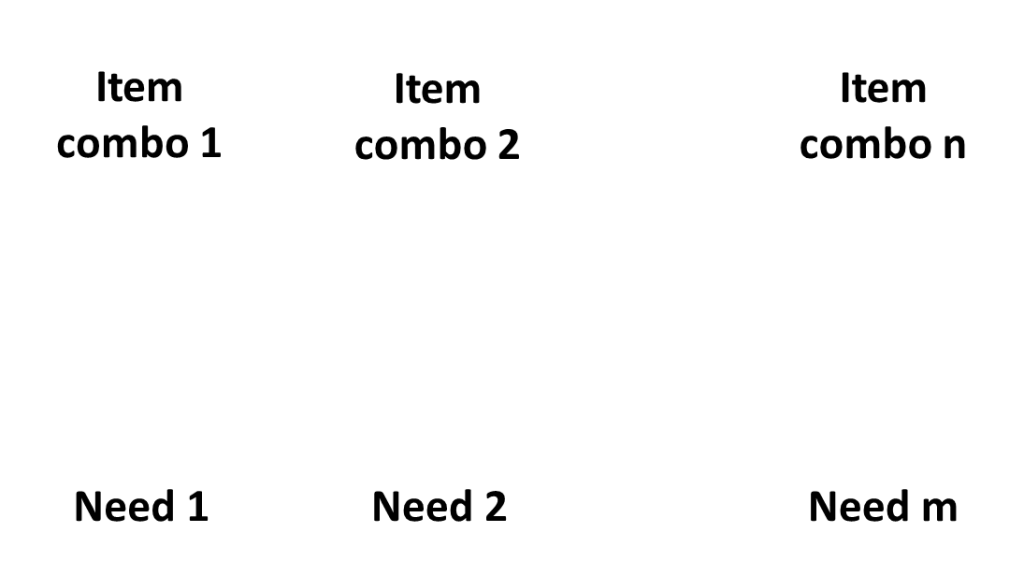
Inventory can be managed directly by decision-owners and can easily optimize for multiple objectives and complex inventory structures. The following are some applications:
- A garage needs to optimize its parts inventory to protect profitability while minimizing customer lead times.
- An investor would like an optimized portfolio that minimizes financial risk while remaining aligned with their moral values.
- An IT department aims to identify the optimal infrastructure upgrades required to meet target user response times.
Certifying products
A company is working toward product certification. They already understand which areas contribute most to meeting the standards and need to find the optimal budget needed to secure certification with confidence.
Operations research
A company managing a supply chain that spans from farms to factories to store shelves is searching for the optimal balance of production at each stage. Their goal is to keep goods flowing smoothly while securing a target stream of revenue.
Conducting surveys
An organization planning a series of surveys wants to cover all the key topic areas without wasting time or money. The challenge is to choose the optimal mix of sampling points, enough to capture the full picture but not so many that costs are excessive.
Want to learn more about how Advanata can find optimal operational actions for your business decision problems?
Sign up for early access to articles, delivered every two weeks. Please check your spam folder for the confirmation email.

Why is Advanata needed?
Decision intelligence approaches have the ability to transform strategic business decisions across all sectors, but the gap between practitioners and decision-owners often leads to decision support results that fail to address the real business decision problems decision-owners are trying to solve.
No single area of expertise is enough
Decision-owners bring Human Intelligence, analysts provide Data Intelligence, and machines deliver Artificial Intelligence. Advanata combines these into Omni-intelligence, seamlessly working together to find optimal operational actions for their business decision problems.
Decision recommendations are both excessive and inadequate
Data-effectiveness is the decision optimization methodology Advanata uses to generate precise and optimal operational actions that decision-owners can easily understand and implement, without the need to study additional decision intelligence output.
Data availability is a persistent barrier
Advanata is information-based and uses an Inductive-approach that first defines the decision structure, minimizing problem scope and data requirements while allowing for viable alternatives even when data is unavailable.
Decision-owners have difficulty framing their problems
The concept of a Business-problem has been developed and is at the core of Advanata to provide a powerful framework to help decision-owners easily and confidently define their business decision problems.
Decision-support is decision-offloading
Decision owners do not have the time to piece together partial solutions or expertise to infer missing components. To ensure decisions are quantitatively complete and operationally actionable a cohesive end-to-end solution must always be provided.
Sign up for early access to articles, delivered every two weeks. Please check your spam folder for the confirmation email.

How can Advanata help?
General-purpose decision support tools are not enough; they require specialized expertise to use and still leave gaps in the business decision problem-solving process. Advanata is built to be different and orchestrates other tools and resources. It is a comprehensive and easy to use decision optimization platform that is ready to handle the real-world business decision problems decision-owners face every day.
Structured optimization platform built for real operational challenges
The flexible decision optimization platform is powerful enough to handle even the most complex strategic operational challenges by focusing on solving real-world business decision problems.
- Solves most business decision problems without the need to start the solution process from scratch.
- Minimizes the data needed and strategic planning work required.
- Easy for decision-owners and other subject matter experts to review, understand, and trust.
Decision-owner-driven from start to finish
Business decision problem decision-owners are involved at every step of the process to ensure better results, deeper engagement, and meaningful solutions.
- Builds buy-in by engaging decision-owners throughout the process.
- Captures problem expertise and turns it into structured, usable information.
- Reduces wasted analysis by starting from what decision-owners already know about their problem.
Actionable results you can use immediately
No more generic dashboards, excessive metrics, or lengthy reports. Just clear, precise optimized operational actions that are immediately usable by the decision-owner.
- Automatically generates optimized operational actions tied directly to decision-owner defined business goals.
- Eliminates the need for additional interpretation or follow-up analysis.
- Confirms the right problem has been solved so decision-owners can act with confidence.
Sign up for early access to articles, delivered every two weeks. Please check your spam folder for the confirmation email.
Advanata is Advanced Data
Advanata is designed for all users and provides an easy-to-use, step-by-step decision optimization platform to quickly deliver optimized operational actions to solve their business decision problems.