

Data is amazing. It can add precision to any evidence, insight to any problem, and objectivity to any decision. Humans (customers) are also amazing. They provide nuanced interpretations of any case, a real understanding of problems, and can think beyond quantitative constraints. While both are important, they are also complementary, and it is essential that they are used together when tackling any analytical problem.

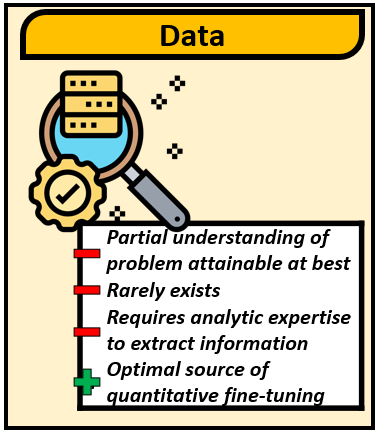
It’s unfortunate how profoundly important human expertise is often underutilized due to the difficulty of integrating qualitative data with quantitative analytical frameworks. For this reason, Advanata was designed from the ground up to provide a robust solution to this issue.
Advanata uses an inductive (top-down) approach with a proprietary framework where the majority of the information describing the problem comes from the customer and is then fine-tuned by data. This approach combines the complementary nature of these two sources to fully and rapidly describe the problem in order to arrive at a solution.
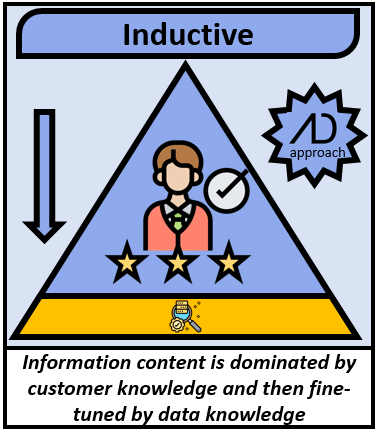
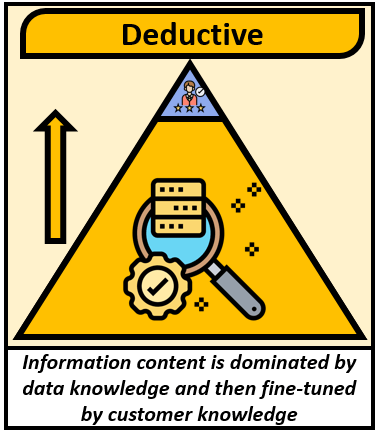
The inductive approach capitalizes on overall problem understanding provided by the customer and is vital when only limited data exists while also allowing for continued refinement as additional data becomes available (Note the similarity to reinforcement learning which has been a major contributor to the recent renaissance in AI models).


Leave a Reply