

Business problems are about finding the best actions to help customers reach their goals. Whether individuals or organizations, customers want real solutions, not additional analytics work.
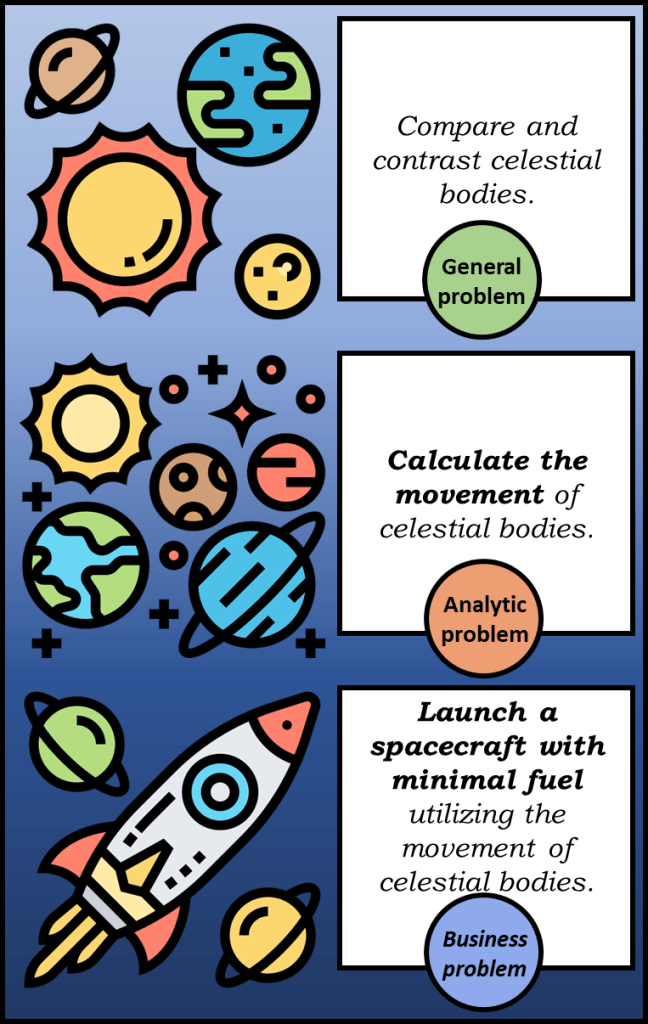
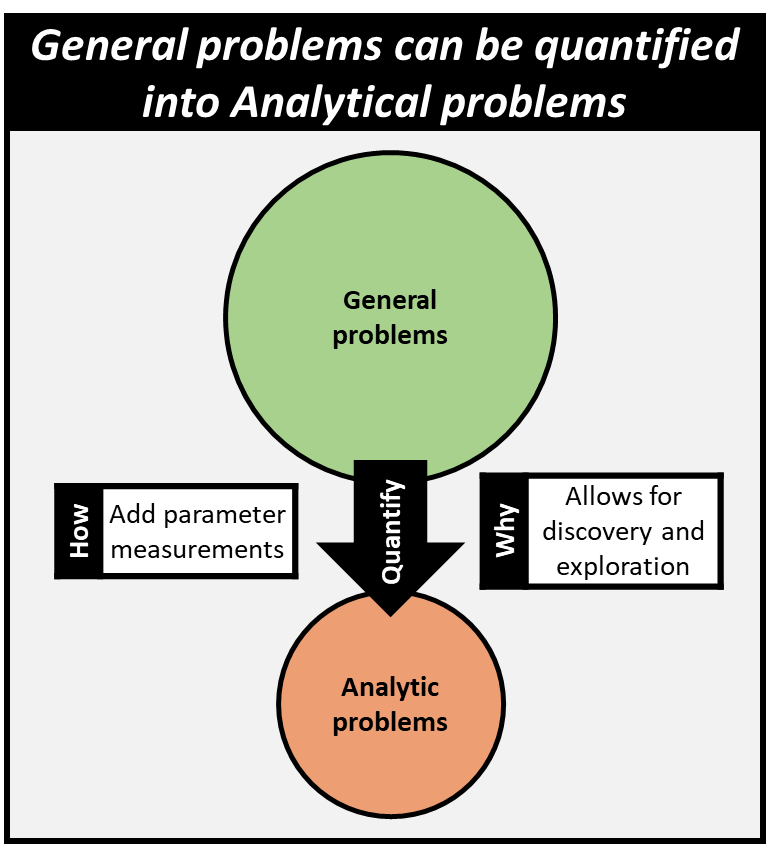
Let’s start from the very beginning. General problems cover all types of problems and can often be converted into Analytic problems through quantification.
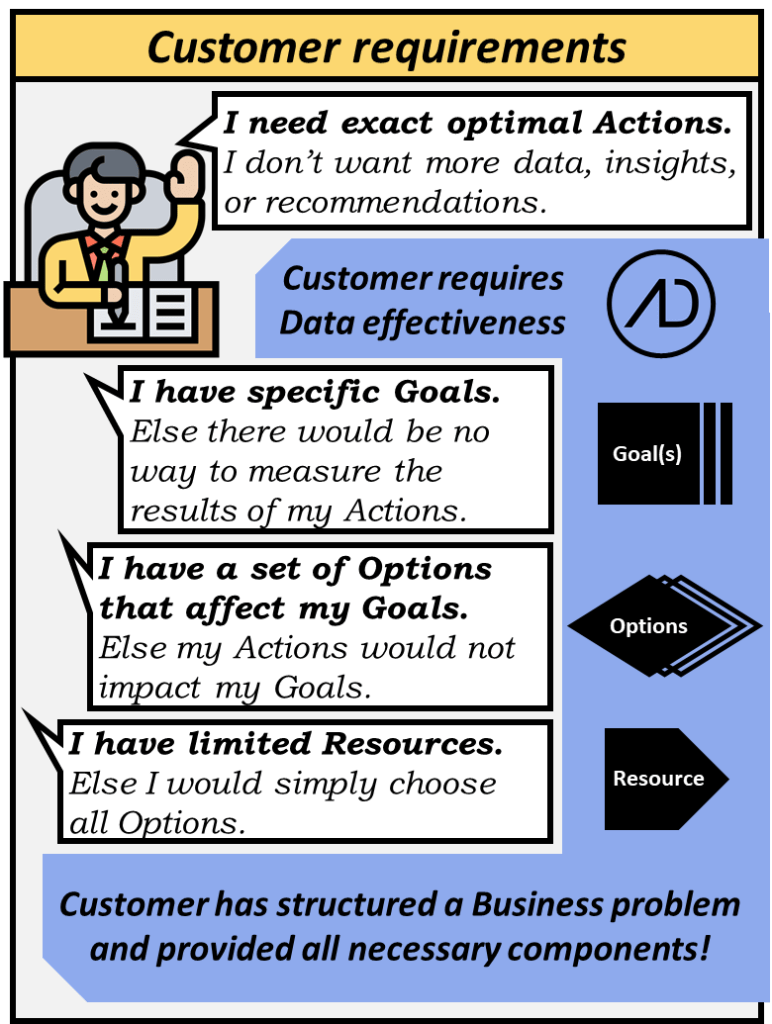
Before examining the next level of problem transformation, let’s start with the customer’s needs. As noted, customers are focused on their own activities and desire optimal actions to solve their problems, not additional analytics research.
To take the right actions, customers first need to define their problem clearly. Surprisingly, this only requires identifying three key elements: Goals, Options, and Resources. If these components exist and can be identified, then we have a Business problem, and the complete structure can be easily entered into Advanata. No intermediaries or complex coding are required; all it takes is simple harnessing of human intelligence.
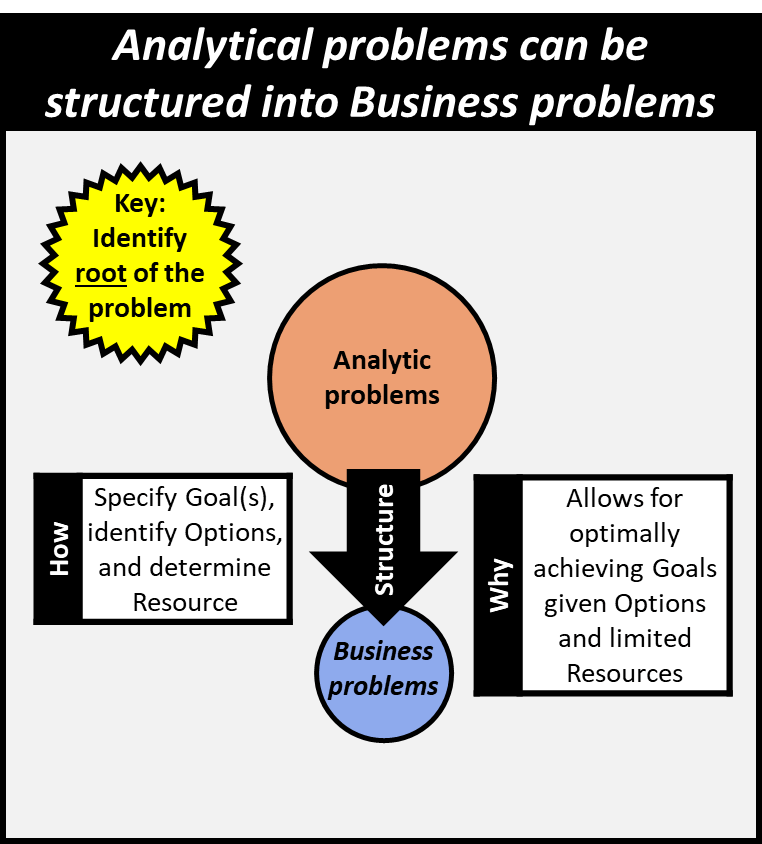
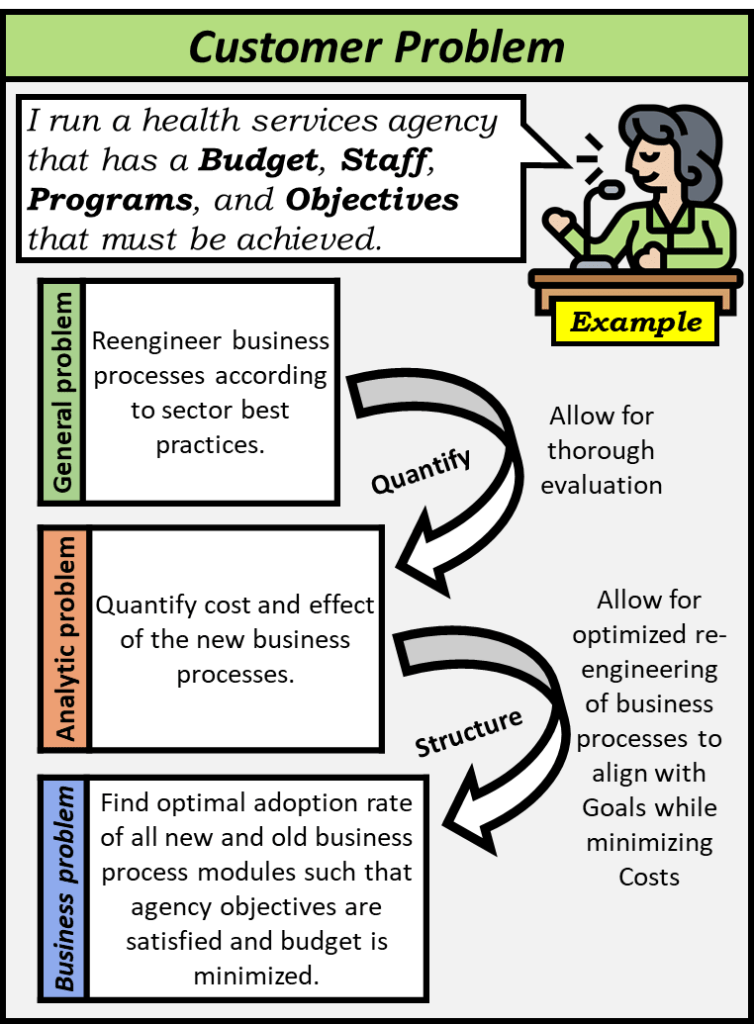
Now we can see how the last step of converting an Analytic problem into a Business problem is performed by adding structure to the problem.
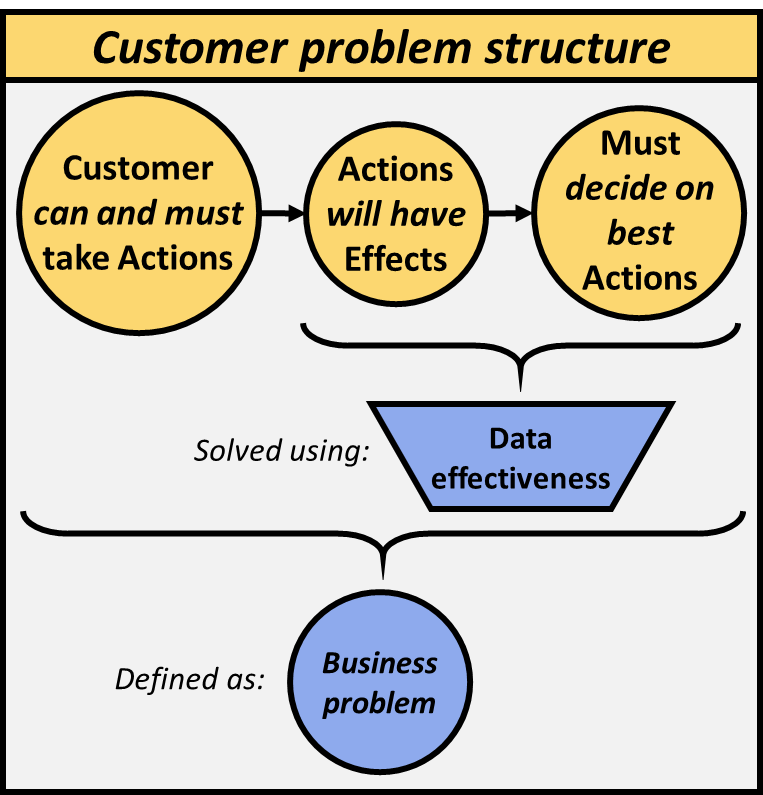
Taking a step back, if a customer needs to take actions, they also expect resultant effects on their Goals and must therefore take the best actions in order to obtain the best effects. This action-and-effect dynamic is solved using Data effectiveness and the entire sequence is a Business problem.
To bring this into practice, consider the following management consultancy style problem. Quantifying the problem helps significantly, as it allows us to measure the costs and benefits of process reengineering. But once the problem is structured as a Business problem, we can go beyond measurement to being able to automatically determine the optimal course of action.
Business problems are a structured form of Analytic problems that produce actionable outputs thus aligning them with customer requirements. The vast majority of real-world problems are in fact Business problems. Advanata is built to solve these problems with maximum efficiency; customers easily input the structural components, fine-tune the parameters, and the optimal solution is automatically generated.


Leave a Reply