
The Secret Recipe for Smarter Pricing

1–2 minutes

This frequently requested example demonstrates how Advanata can be used to optimally adjust prices. The problem applies across many domains, with this case adding the twist of incorporating a highly subjective goal.

Menu Pricing Problem

A restaurant needs to raise prices to stay afloat while keeping their patrons loyal. They have ample sales data but aren’t sure where to begin. What could be an endless analytics project can be optimally solved with Advanata.
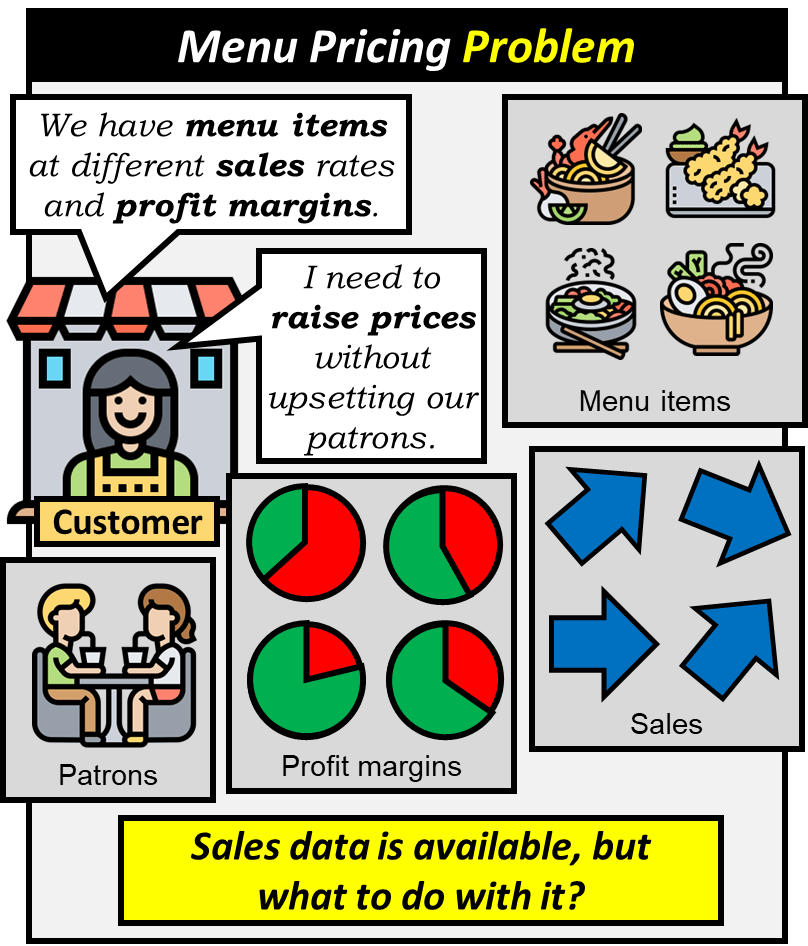
Restaurant owner has menu items at different sales rates and profit margins. They need to raise prices without upsetting their patrons. Sales data is available but what to do with it?

Menu Pricing Preparation

With a few inductive steps and their business knowledge, the customer can convert their vague statement about patrons into a measurable goal.
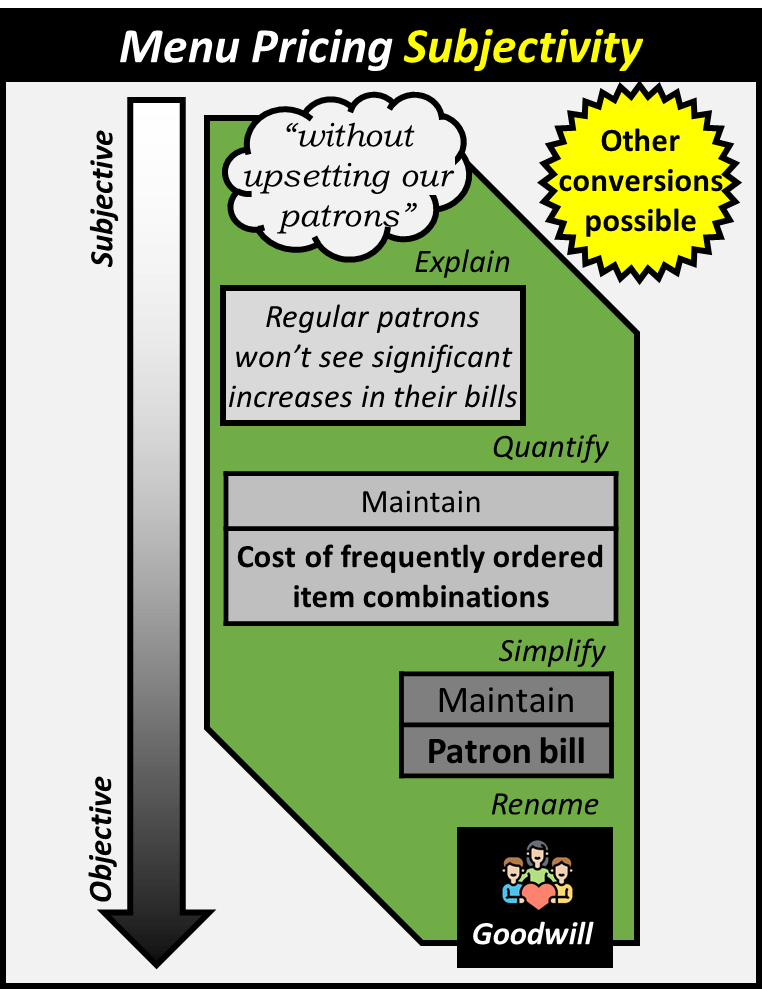
"without upsetting our patrons" is a subjective statement. Explaining it to mean "Regular patrons won't see significant increases in their bills". Quantifying it into maintaining the cost of frequently ordered item combinations. Simplifying it into maintaining a patron bill. Finally, renaming it into "Goodwill" concludes the process and the goal is entirely objective. Note that other conversions are possible.

The key step is defining objective goals from the customer’s initial question. This is straightforward for profitability but more involved when addressing patron loyalty.
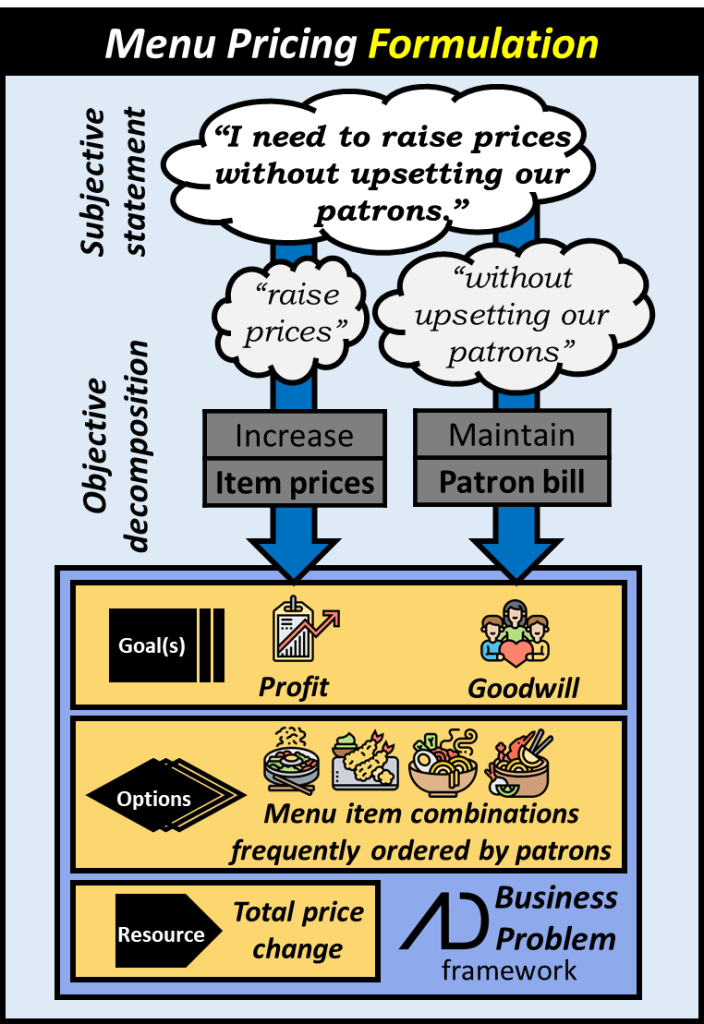
Starting from the subjective statement "I need to raise prices without upsetting our patrons" can be divided into two goals. "Raise prices" means increasing item prices which can be labeled as a 'profit" goal. Then "without upsetting our patrons" can mean maintaining the patron bill and results in the goal "goodwill".  Options are the menu items frequently ordered by patrons and the resource is the total price change. This is the business problem framework from Advanata.

Turning a subjective customer problem into a clearly defined, solvable objective one is a hallmark of Advanata‘s inductive approach.
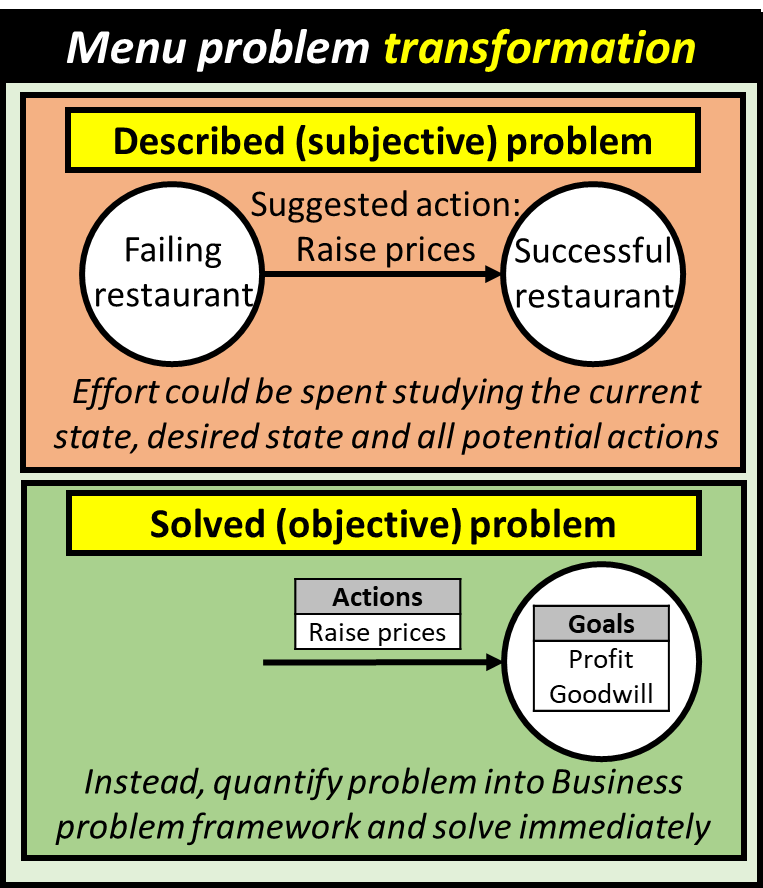
The described subjective problem consists of starting with a failing restaurant that wants to become a successful restaurant by raising prices. Effort could be spent studying the current state, desired state all potential options. The solved objective problem only requires taking "raising prices" as the action and the defined goals of "Profit" and "Goodwill", placing them into the business problem framework and solving immediately.

Menu Pricing Process

Solving this problem is more involved but immensely valuable. The customer defines a hierarchy of commonly ordered combinations and standalone menu items, and the analyst adjusts the rate matrix for each.

Customer only wants to change prices in order to increase their profit by 10% and minimize impact to goodwill. They enter the structure into Advanata's business problem framework components and define their goal targets. The analyst then creates a rates matrix consisting of the menu items, sales, and profit margins all adjusted by item combinations. Advanata then solves this problem and outputs the optimal menu price adjustments. to reach the desired goals.

This example can be expanded to include additional objective goals, like staff efficiency or table turnover, as well as subjective goals, such as customer satisfaction or signature dish appeal. The concept of adjusting only prices can also be extended to changing ingredients or portion sizes.

Similar Problems

Many fascinating similar problems arise, especially when turning subjective goals into objective ones. While slightly more challenging than typical Advanata applications, the payoff far exceeds the added complexity.

Similar problems exist. Adjust product discounts to raise revenue while preserving brand image. Optimize factory production to ensure adequate market supply and reduce waste. Refine budget cuts to minimize community impact while satisfying institutional goals. Raise utility rates to recover costs while minimizing impact on vulnerable customers. Rates can be derived from available data and refined using customer expertise. Any subjective goals can be included if they can be identified.

Solving Unique Problems

While this example would be simple with only objective goals, it highlights how Advanata can be applied to important yet seemingly unlikely challenges. Built on powerful technologies and true multi-goal optimization, Advanata adapts naturally to increasing challenges and delivers greater impact as problems grow in complexity.

Sign up to get the latest articles and product updates.

Ready to see Advanata in action? Explore more resources, read related articles, and access the full application at advanata.com.

Want a personalized walkthrough? Contact info@advanata.com to get application access and schedule a demo.

Leave a comment