

Why Are Consulting Reports So Long?

2 minutes

Anyone who has read a consulting report knows how long they can be. No one wants lengthy reports, yet they persist. Why does this happen, and is it accidental or inevitable? More importantly, how can we shorten them to benefit both customers and consultants? This article explores why consulting reports are so long and how Advanata can intelligently help to reduce their length.
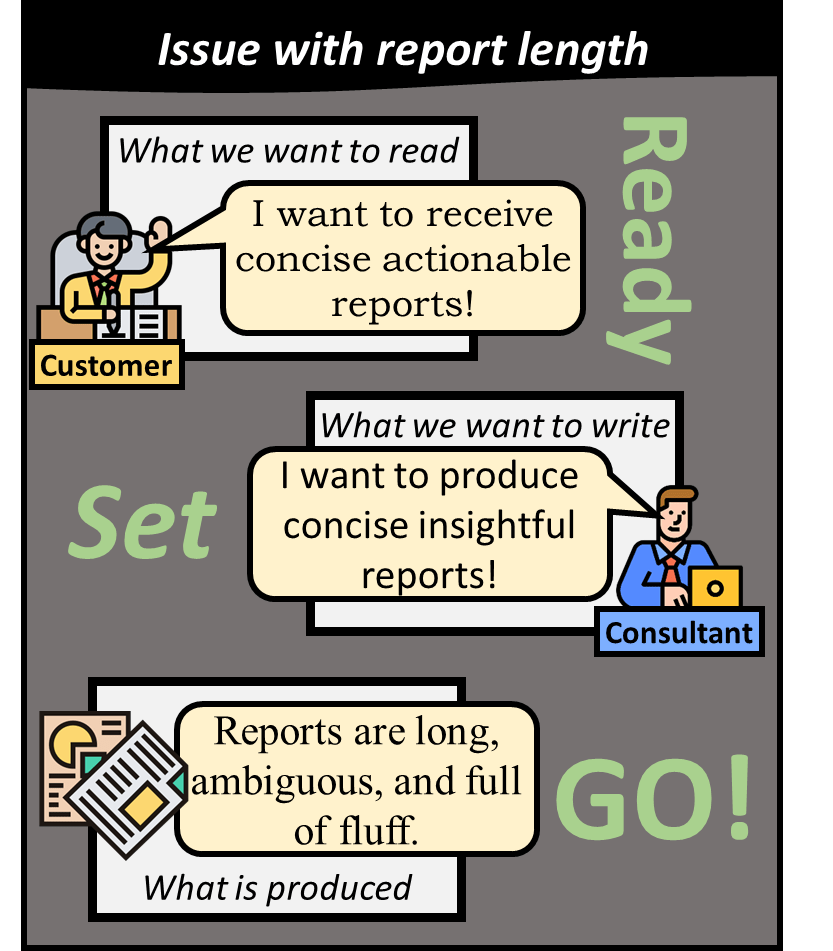
Customers want to receive concise actionable reports. Consultants want to produce concise insightful reports. However, the result is that reports are long ambiguous and full of fluff.

The Theory Behind Long Reports

When output quality is hard to observe, report length becomes a proxy for value. This results in long reports and also shifts risk and accountability entirely to the customer.
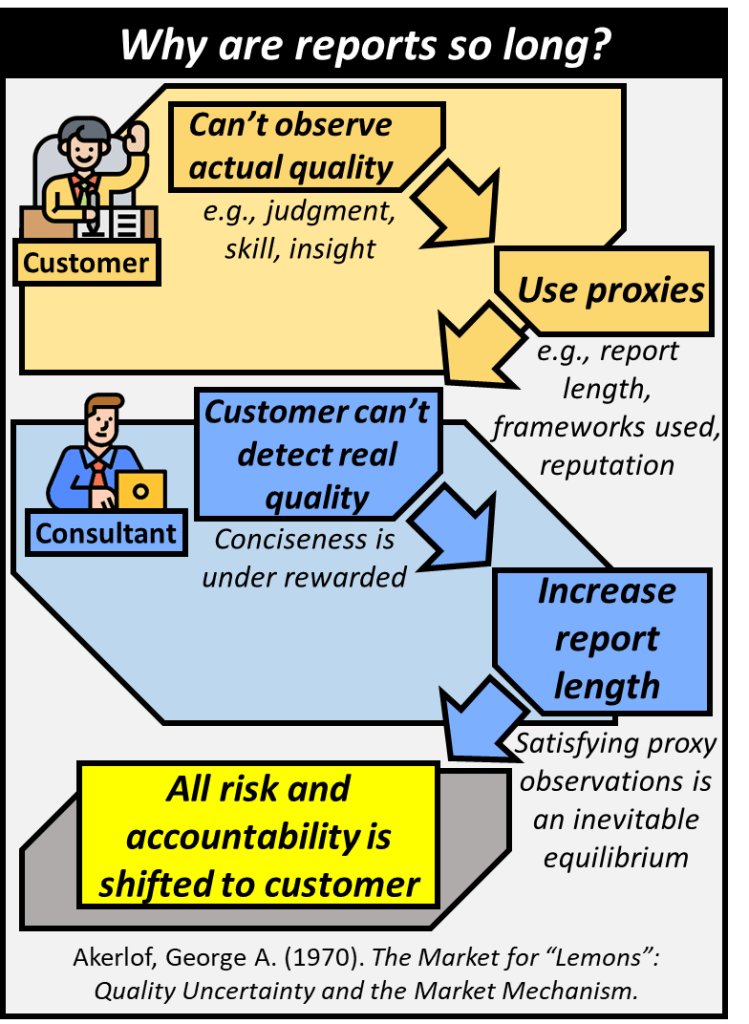
Customer can't observe actual report quality so they rely on proxies. Consultant knows that customers cant detect real quality so they increase report length to satisfy the proxy evaluation criteria. This is an inevitable equilibrium and the result is that all risk and accountability is shifted to the customer.

Why Quality Isn’t Observable

Screening for quality falls to the customer, but it is difficult and contentious. As a result, they default to standard playbooks and expect bulky reports that demonstrate thoroughness.
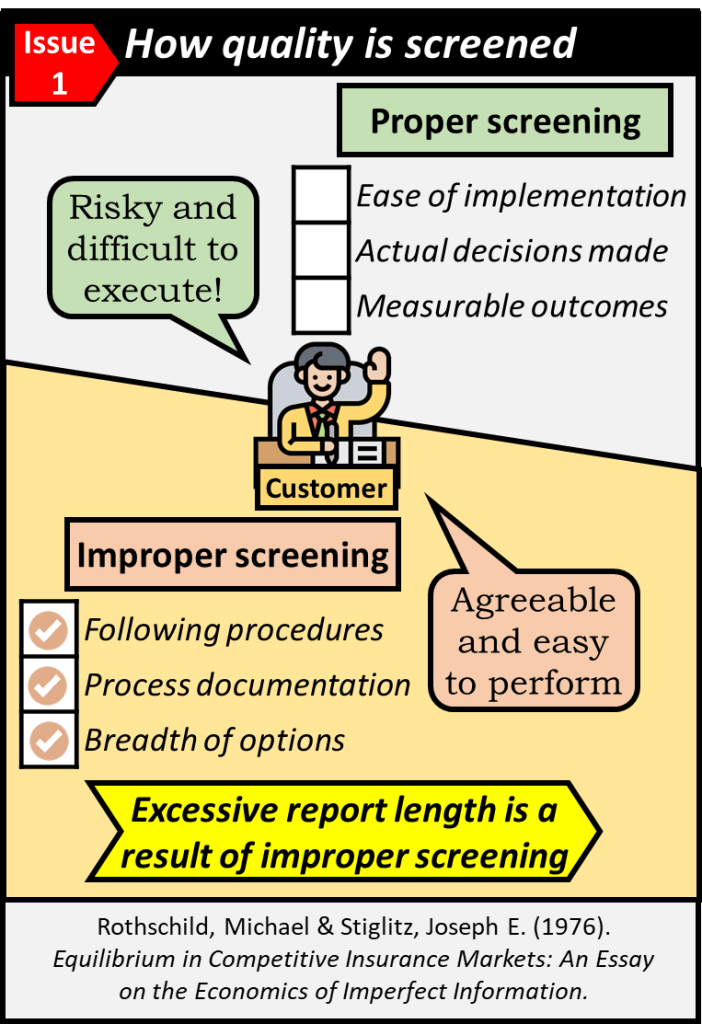
Proper screening of quality consists of evaluating ease of implementation, actual decisions made, measurable outcomes. However, this is risky and difficult to execute so the result is improper screening which is agreeable and easy to perform and consists of following procedures, process documentation, and breadth of options. This all leads to excessive report length.

Consultants are expected to indicate quality, but those indicators are hard for customers to observe. This leads to producing excessive content as proof of tangible effort.
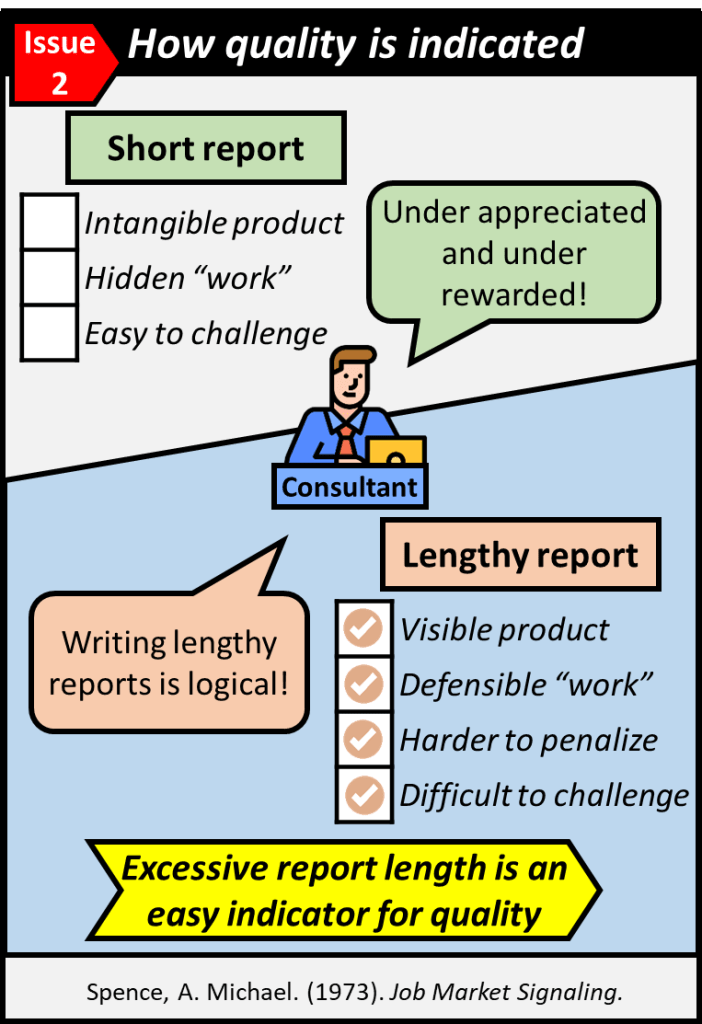
A short report contains an intangible product, hidden work and is easy to challenge. This is under appreciated and under rewarded. The only logical solution is to write a lengthy report that demonstrates a visible product, defensible work and is harder to penalize. Therefore, a long report is an easy indicator for quality.

Fixes to Enforce Quality

Quality is best ensured through self-enforcement. Consultants who accept accountability show confidence in their work.
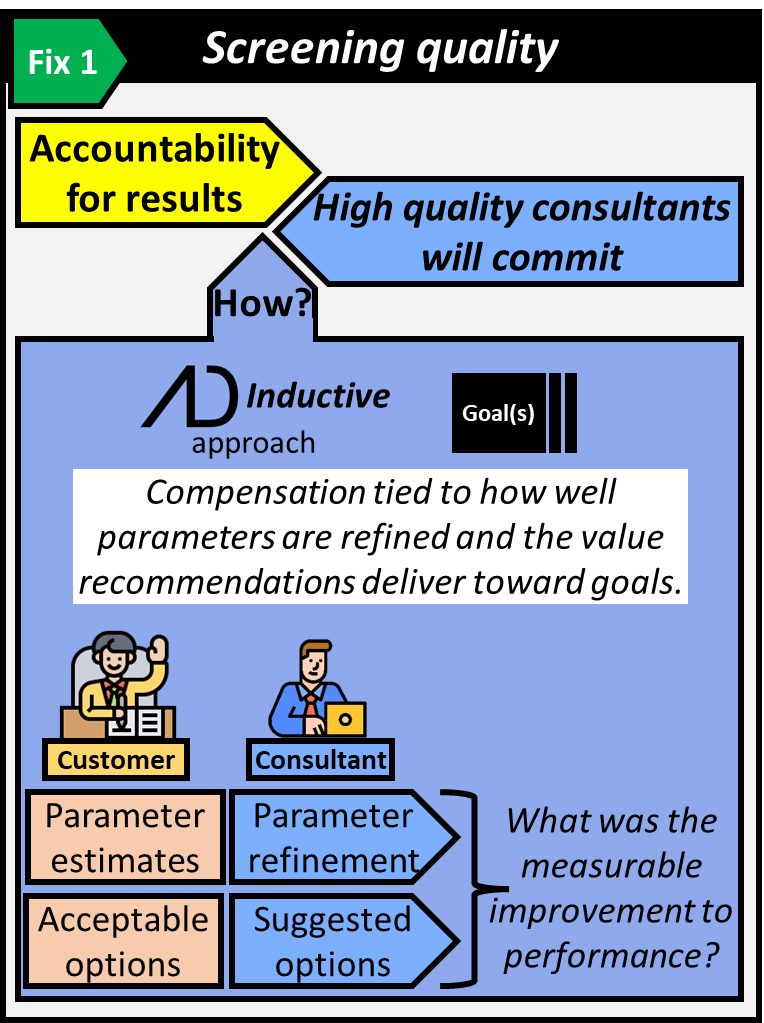
The best way to screen for quality is through accountability for results. High quality consultants will commit to such accountability. Compensation is tied to how well parameters are refined and the value recommendations deliver toward achieving specified goals. This is a result of having the inductive approach and specific goals.

Indicating quality is also self-enforcing by restricting the range of the solution. Consultants with solid subject expertise can outline solution paths and set expectations early.
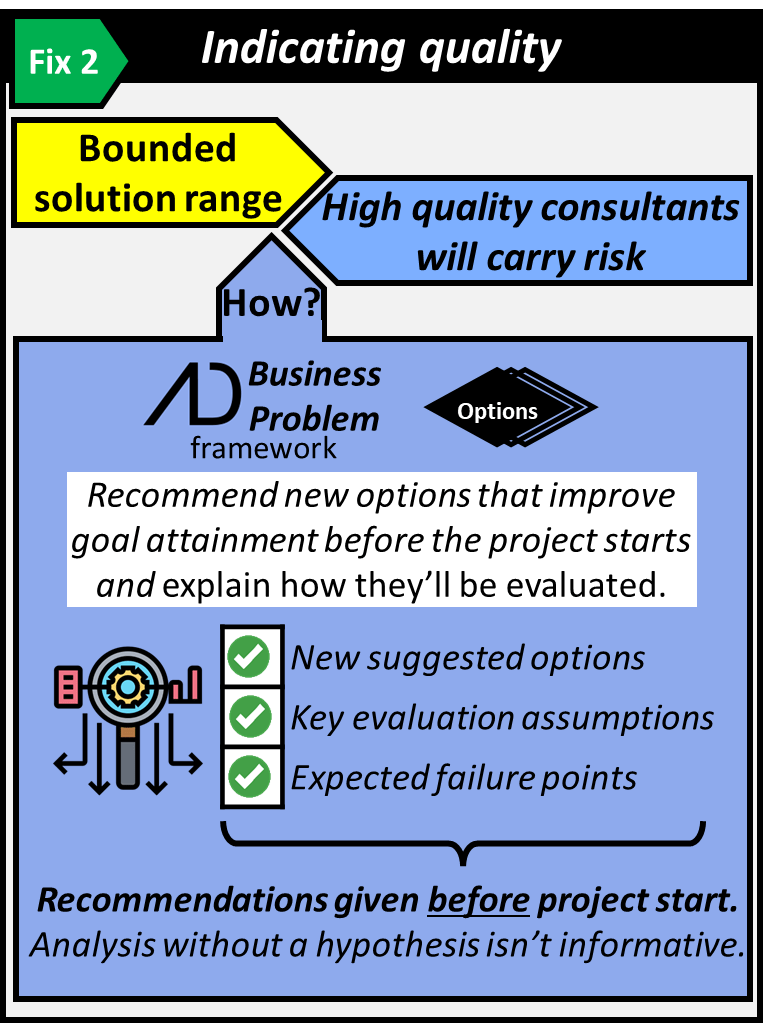
Indicating quality can be done by bounding the solution range and high quality consultants will carry this risk. Recommending new options that improve goal attainment before the project starts and explain how they'll be evaluated. These recommendations must be given before the project starts since analysis without a hypothesis isn't informative. The business problem framework and its definition of options enables this indicator.

Selecting quality is achieved through precise problem definition using data effectiveness to output the exact solution. This final fix eliminates report padding and supports comprehensive customer review.
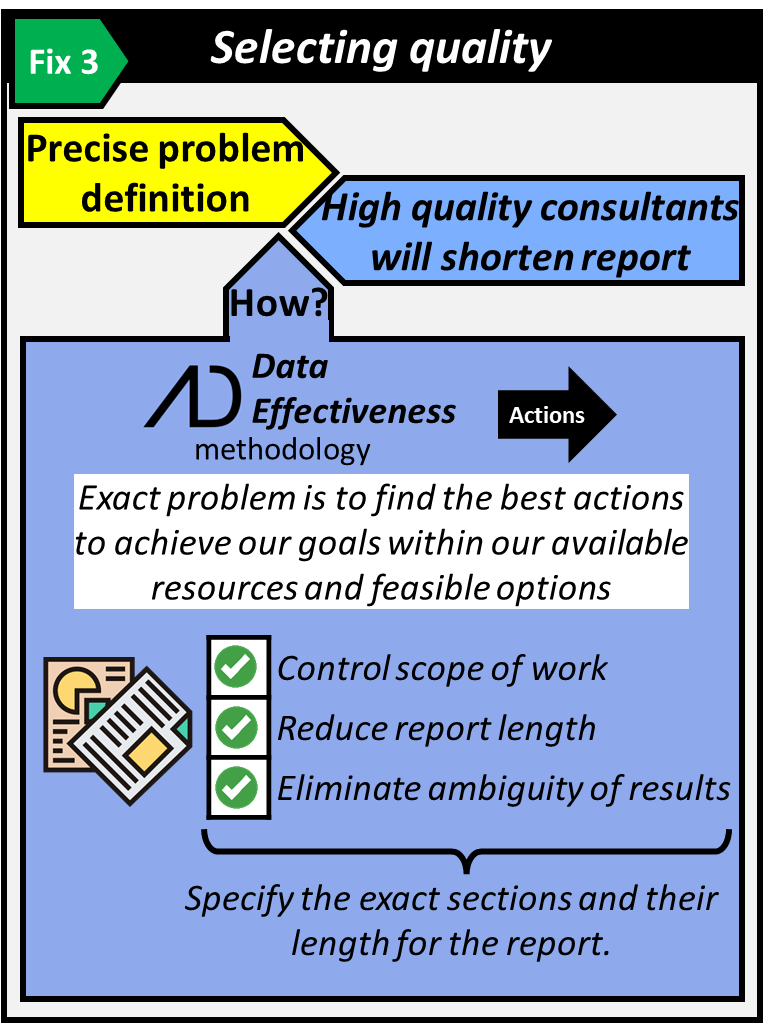
Selecting quality requires precise problem defintion. High quality consultants will shorten their reports. exact problem is to find the best actions to achieve our goals within our available resources and feasible options. We need to specify the exact sections and their length to control the length of the report. The data effectiveness methodology enables this selection criteria.

Does This Fix Everything?

A few fixes will not fully eliminate the legacy of long reports, but they are a step in the right direction. Advances in large language models (LLMs) are pressuring consulting, making it essential to evolve and preserve value for their customers.
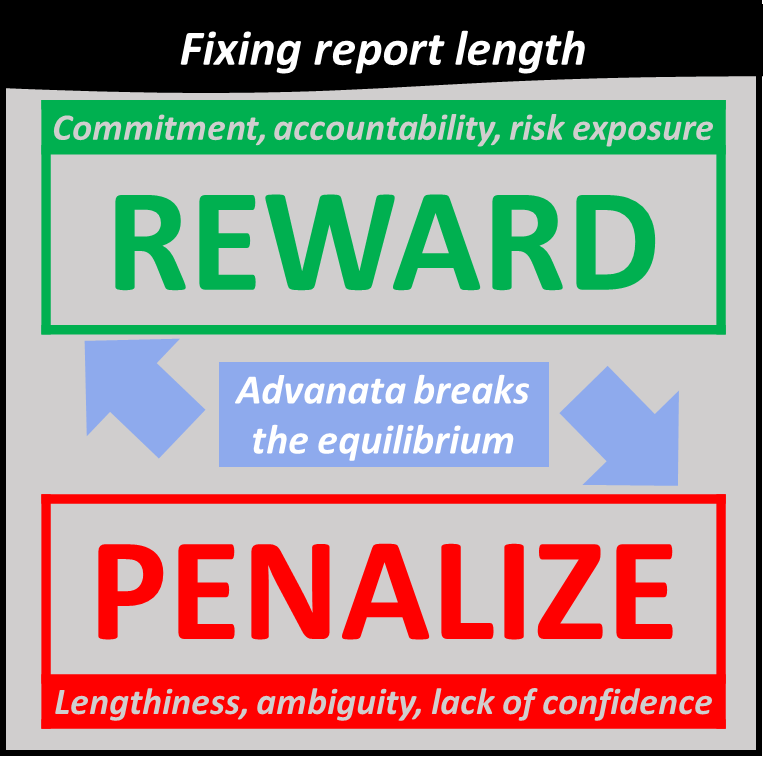
Advanata breaks the equilibrium by rewarding commitment, accountability, and risk exposure while penalizing lengthiness, ambiguity, and lack of confidence.

Long reports benefit no one and must be addressed before LLMs end up handling both writing and reading them. Advanata’s solution framework helps neutralize this issue at its core and is designed to be useful to everyone, whether producing or consuming reports.

Sign up for early access to articles, delivered every two weeks. Please check your spam folder for the confirmation email.

Ready to see Advanata in action? Explore more resources, read related articles, and access the full application at advanata.com.

Want a personalized walkthrough? Contact info@advanata.com to get application access and schedule a demo.

Leave a comment