

Sharper, Better, Leaner, Clearer Business Analytics

2 minutes

What is business analytics really about? More importantly, what can it actually be used for? This article examines the contemporary classification of business analytics, what it can and cannot do, and its role in Advanata’s business decision optimization framework.

Popular Classification

Most business analytics definitions classify analytics into four types. While this may seem logical, closer examination reveals that the classification combines several disciplines beyond analytics, which may explain why analytics projects often fall short of expectations.
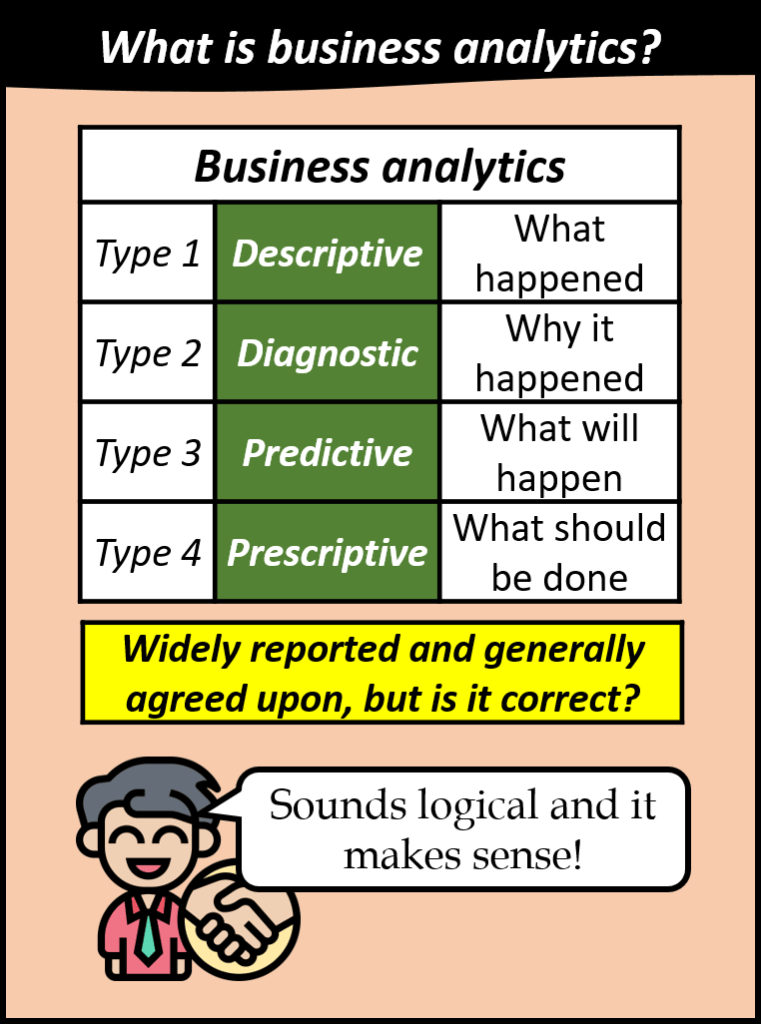
Business analytics are popular classified into four types. Type one is descriptive and tell us what happened. Type two is diagnostic and tells us why it happened. Type three is predictive and tells us what will happen. Type four is prescriptive and tells us what should be done. Widely reported and generally agreed upon but is it correct?

Examining the Four Types

Describing the past is essentially extracting relevant data. This is a difficult and often overlooked task yet frequently left to anyone with rudimentary data handling skills. Recurring accounting scandals demonstrate how critical this task is and why it requires deep subject expertise rather than analytics expertise.
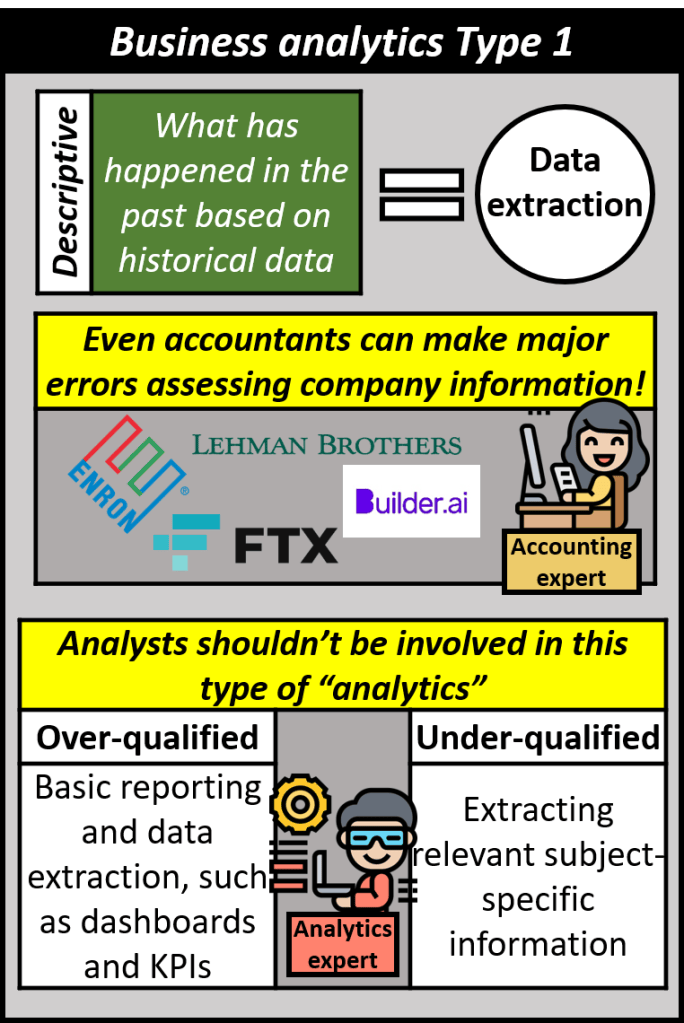
Type one business analytics are descriptive in that they tell us what happened in the past based on historical data. This is essentially data extraction. Even expert accountants can make major errors assessing company information (Enron, Lehman brothers, FTX, Builder.ai are just examples). Analysts shouldn't be involved in the type of "analytics". Analysts are over qualified for basic reporting and data extraction such as dashboards and KPIs, while they are under qualified for extracting relevant subject specific information.

A popular view divides core analytics into understanding the past and forecasting the future. The reality is that they are fundamentally the same. If we truly understand past behavior, we understand the mechanisms that produced it, and those mechanisms can be used to predict future behavior. This is a challenging task and precisely why analysts are needed.
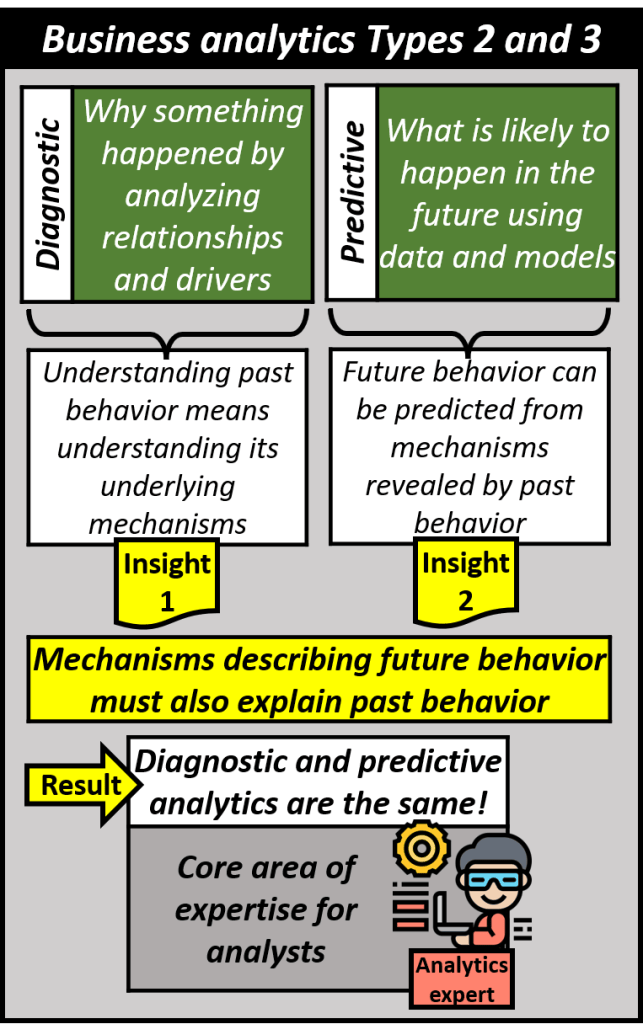
Business analytics type 2 is descriptive in that it tells us why something happened by analyzing relationships and drivers. The key insight is that understanding past behavior means understanding its underlying mechanisms. Type three business analytics is predictive in that it tells us what is likely to happen in the future using data and models. Again, the key insight here is that future behavior can be predicted from mechanisms revealed by past behavior. Putting these two insights together reveals that mechanisms describing future behavior must also explain past behavior. The result is that diagnostic and predictive analytics are the same and are the core area of expertise for analysts.

Reducing prescriptive analytics to simply putting everything together in the form of insights or general recommendations is a tragic oversimplification. The process is highly complex, requires multiple experts, and is often incomplete or flawed, with the results reflecting those shortcomings.

Business analytics type four is prescriptive in that it recommends actions to achieve desired outcomes based on objectives and constraints. What is needed to recommend actions can be quite a complex process whereby the decision owner defines constraints, objectives, options, and estimates behavior. The analytics expert calculates behavior. The subject expert can suggest options and estimate behavior. The optimization expert calculates actions. Actions need objectives which need constraints. Actions also need options which need behavior which need content. All of this is far too complex for an analyst to perform on their own.

Type 4 business analytics is essentially data effectiveness, which is what Advanata was designed to deliver. It transforms an ad hoc, complex process with uncertain results into an efficient, well-defined process designed to output precise outcomes for the analytics customer.
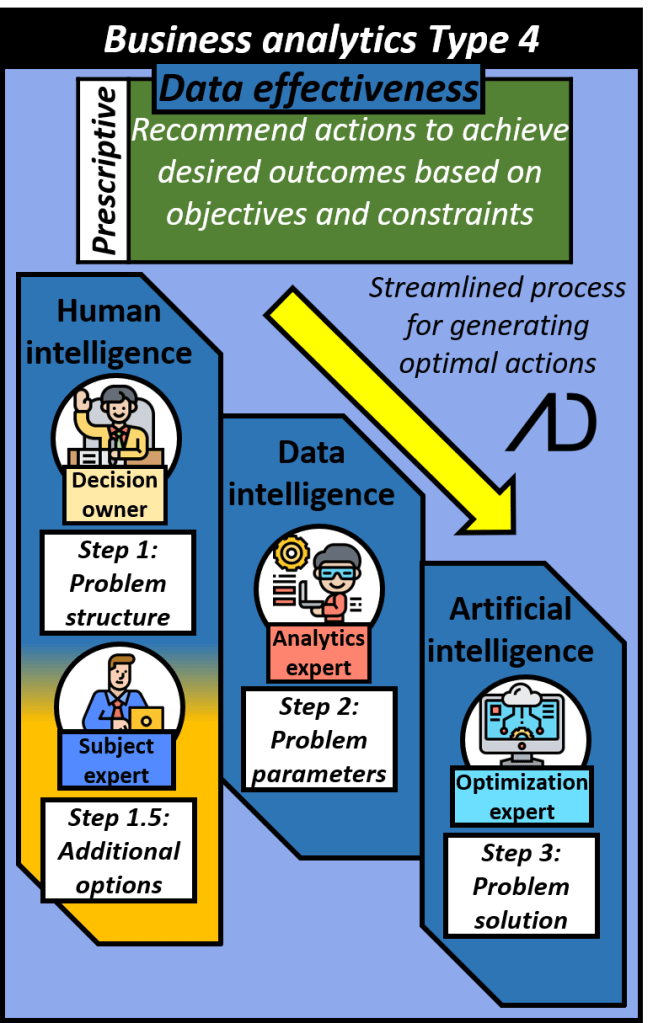
Business analytics type four (prescriptive) is essentially data effectiveness. Advanata provides a streamlined process for generating optimal actions where step 1 is an application of human intelligence where problem structure is provided by the decision owner and potentially supplemented by the subject expert to provide additional options. Step two is data intelligence which provides problem parameters which can be done by the analytics expert. Finally, step three is artificial intelligence where an optimization expert provides a problem solution.

True Scope of Analytics

Analytics is in reality a far narrower and deeper field than the popular definition suggests. Modeling behavior alone is a formidable task that requires significant expertise. However, when done properly it is extremely valuable and can greatly improve the accuracy of results.
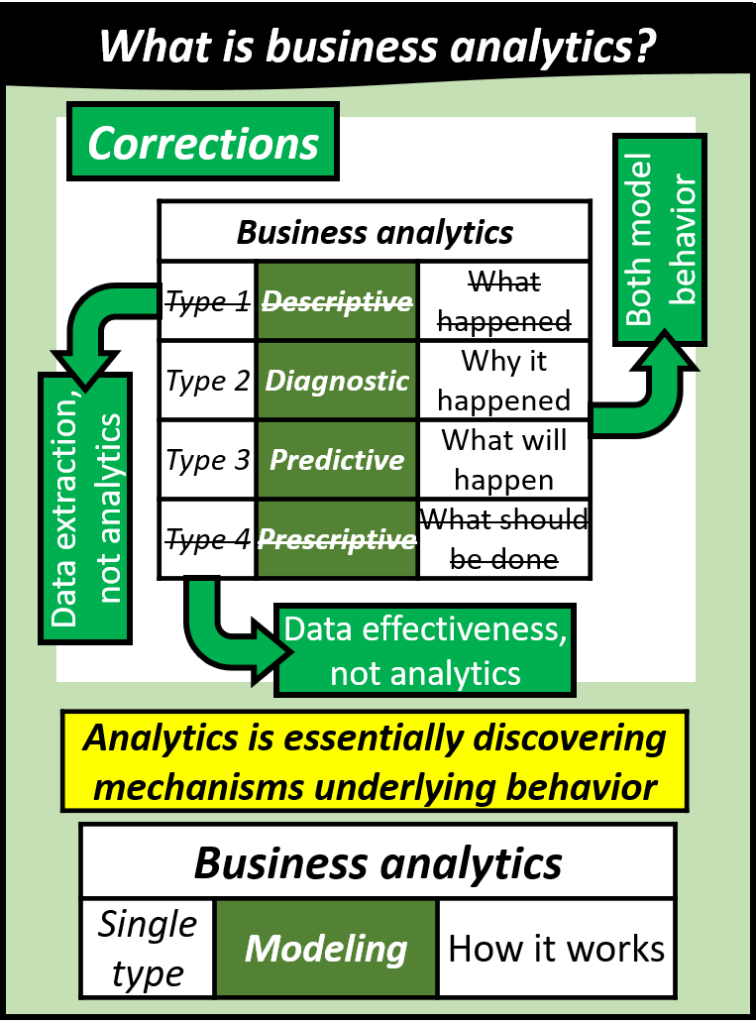
What is the correct classification of business analytics? Type one descriptive is data extraction and not analytics. Type four is data effectiveness and not just analytics. Types two and three are the same since they both model behavior. Therefore, analytics is essentially discovering mechanisms underlying behavior. Business analytics is therefore just a single type called modeling where we want to find out how it works.

Data Effectiveness, Go Beyond Analytics

The conventional four-level classification makes business analytics appear broader and simpler than it really is. True analytics is a narrow, deep discipline, while producing effective decisions requires additional capabilities. Advanata brings these capabilities together in a structured, easy-to-use framework that engages the right expertise at each stage to turn complex business problems into precise, optimal actions.

One quick poll question (3 seconds):
I’d really value your input.

Sign up for early access to articles, delivered every two weeks. Please check your spam folder for the confirmation email.

Ready to see Advanata in action? Explore more resources, read related articles, and access the full application at advanata.com.

Looking for a personalized walkthrough or decision intelligence consulting? Contact info@advanata.com to get application access, schedule a demo, or discuss your decision optimization challenges.

Leave a Reply