

Data Effectiveness vs. Traditional Decision Support Approaches

2 minutes

Several approaches are commonly used for decision support. What are they, and are they enough to fully solve business decision problems? How does Advanata’s data effectiveness approach differ from these methods, and how can they complement each other?
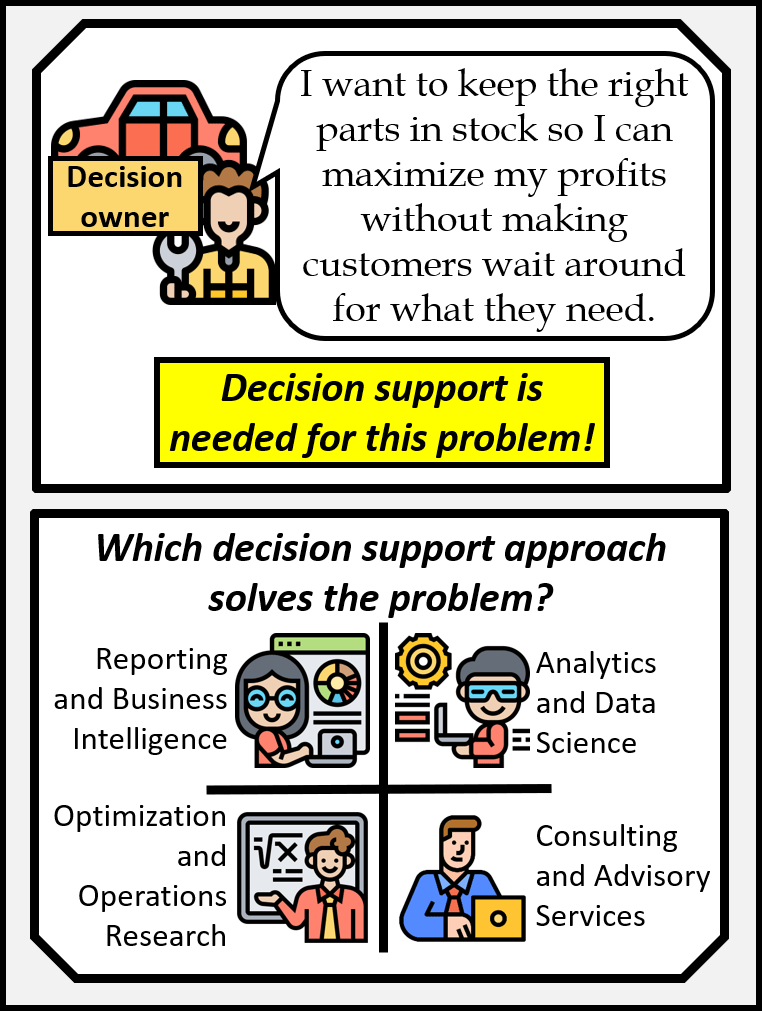
A decision owner wants to keep the parts in stock so that they can maximize their profits without making customers wait for what they need. Decision support is needed for this problem. Which decision support approach solves this problem? Reporting and business intelligence, analytics and data science, Optimization and operations research, or Consulting and advisory services?

Traditional Decision Support Approaches

Each approach produces content that is considered ‘information’ when it fully satisfies the problem requirements, or ‘data’ when it requires further quantification.

A common approach, yet often mistaken for analytics, is dashboards and related reporting. While useful for monitoring operations, they are far removed from solving the actual decision problems businesses face.
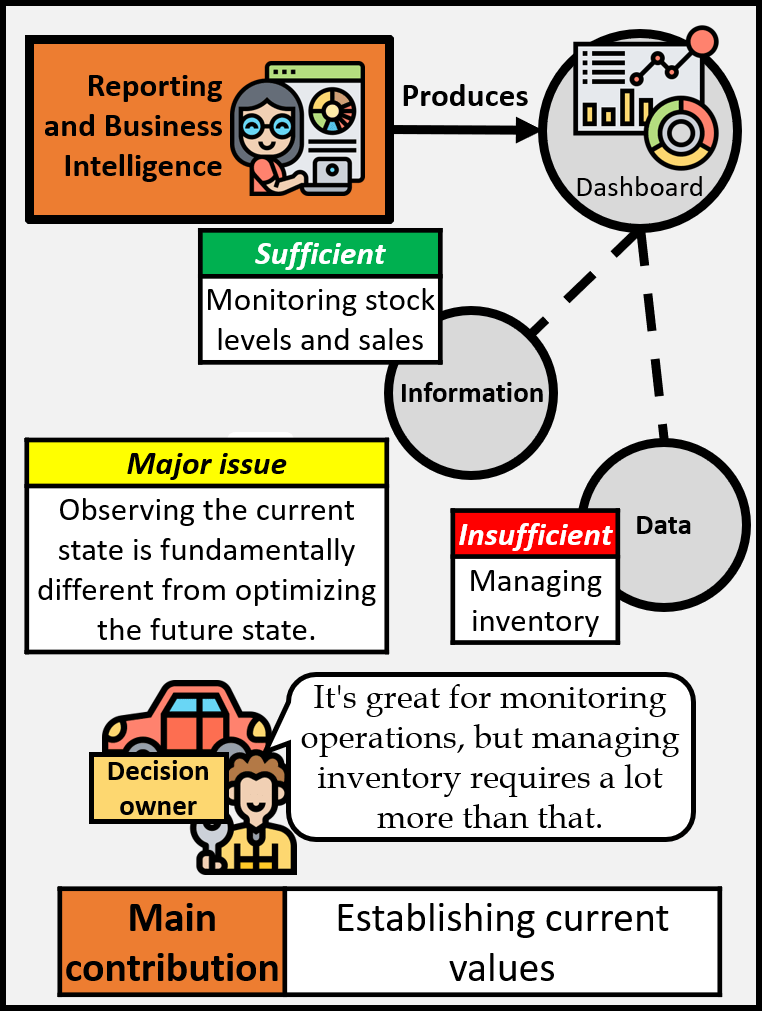
Reporting and business intelligence produces content such as dashboards. This is considered information and is sufficient for monitoring stock levels and sales but is insufficient for managing inventory and is considered data. The major issue is that observing the current state is fundamentally different from optimizing the future state. While this is great for monitoring operations, managing inventory requires much more work. The main contribution is that it can establish current values.

Analytics are a key part of decision-making, but they do not provide complete solutions and still leave gaps that can prevent reaching an optimal outcome.
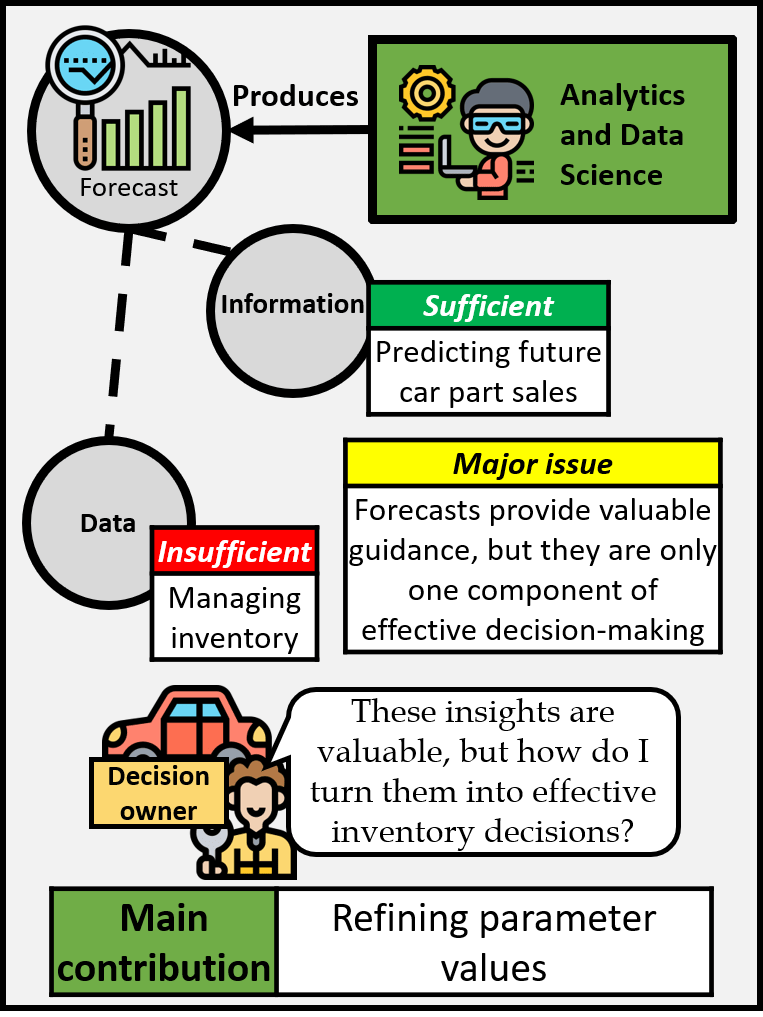
Analytics and data science can produce content such as forecasts which are sufficient for predicting future car part sales and are considered information but are considered data and are insufficient for managing inventory. The major issue is that forecasts offer valuable guidance but they are only one component for effective decision making. These insights are valuable but how can they be turned into effective inventory decisions? The main contribution is refining parameter values.

Finding an optimal solution is central to decision-making, but getting there requires significant effort to properly frame the problem and reach a final solution.
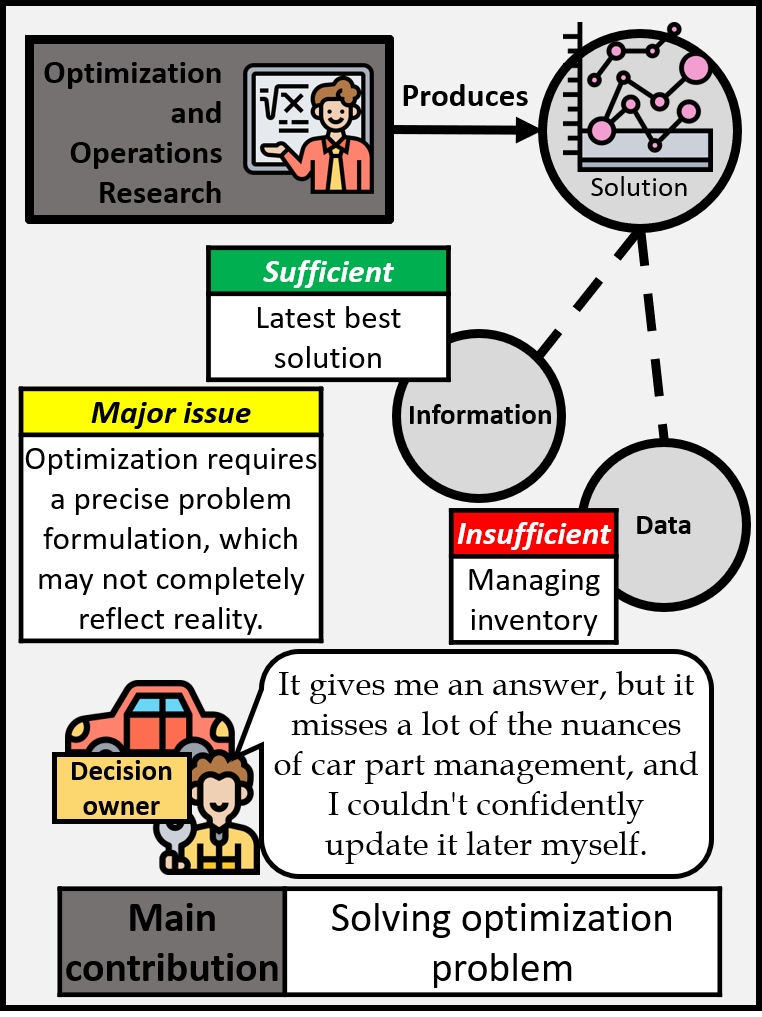
Optimization and operations research can produce solutions which are sufficient if we need the latest best solution and are considered information but if we need to manage inventory they are only data and insufficient. The major issue is that optimization requires very precise problem formulation which may not completely reflect reality. It will give an answer, but it misses a lot of the nuances of car part management and can't be confidently updated by the decision owner themselves. The main contribution is that i solves an optimization problem.

Recommendations, even when quantitatively driven, are still incomplete and require additional work to turn them into optimal decisions.
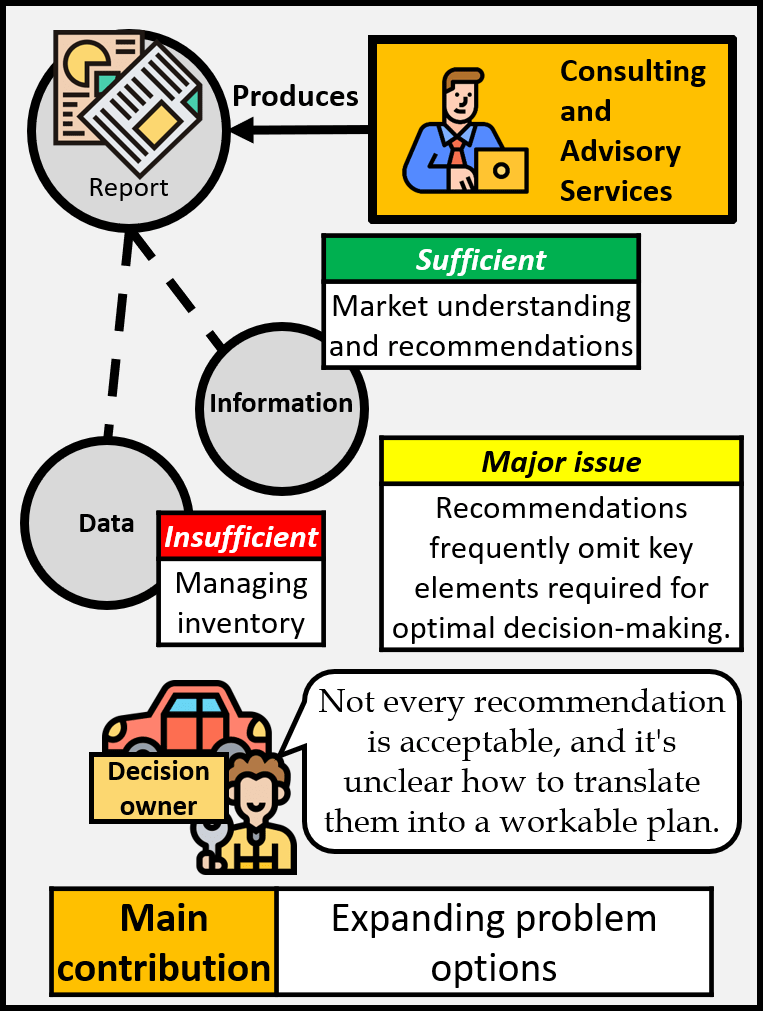
Consulting and advisory services produce reports which are sufficient for market understandin and recommendations and are considered information but they are insufficient for managing inventory and are only considered data. The major issue is that recommendations frequently omit key elements required for optimal decision making. Not every recommendation is acceptable and it's unclear how to translate them into a workable plan. The main contribution is that they expand problem options.

Data Effectiveness for Decision Optimization

Advanata uses data effectiveness as its core decision optimization approach and can be used independently by decision owners to solve most business decision problems. In addition, its problem-solving capability can be further enhanced when combined with other approaches.
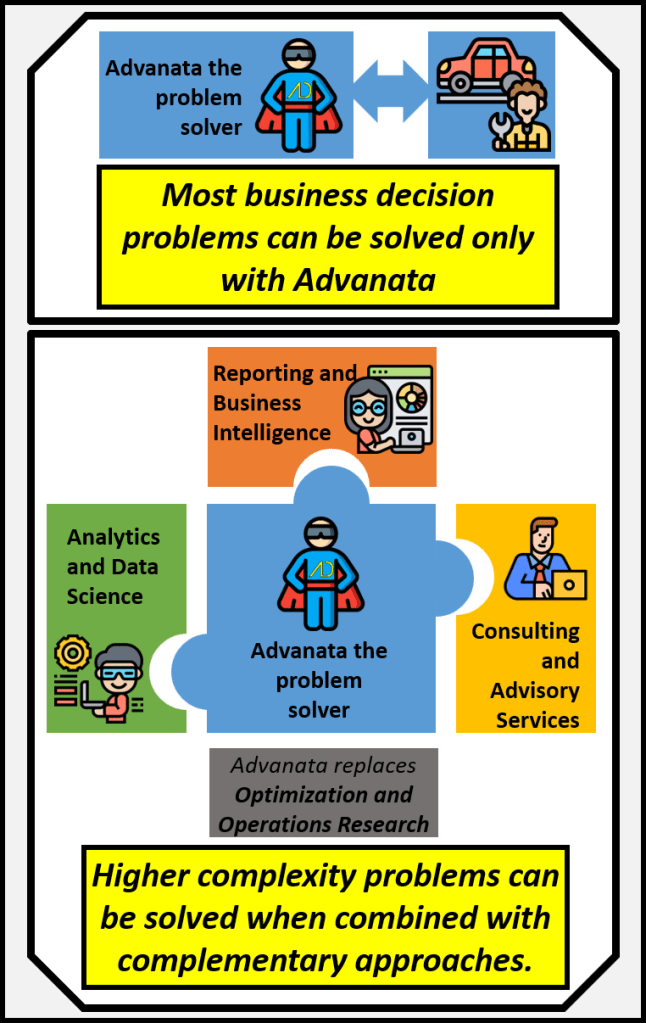
The decision owner can use Advanata to solve most business decision problems independently. While Advanata completely replaces the need for optimization and operations research, other decision support approaches can complement Advanata to solve higher complexity problems.

The decision owner must have sufficient problem expertise to structure the business decision problem. Subject matter expertise can enhance this structure by adding options that expand the range of possible solutions.
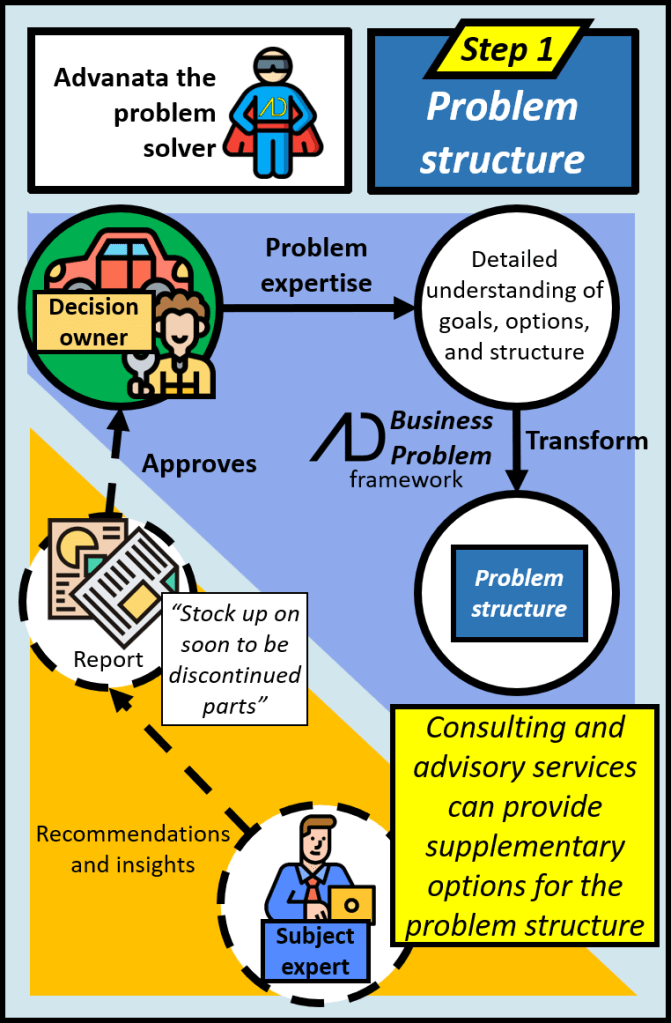
The decision owner has the problem expertise to provide a detailed understanding of the goals, options, and structure of the problem which can then be transformed using the business problem framework into problem structure. Consulting and advisory services can provide supplementary options for the problem structure such as "stock up on soon to be discontinued parts" which the decision owner can decide whether to incorporate into the structure.

Analytics expertise enables sophisticated parameter estimation when supporting data is available. When it is not, parameters can still be approximated using alternative approaches under the guidance of the decision owner.
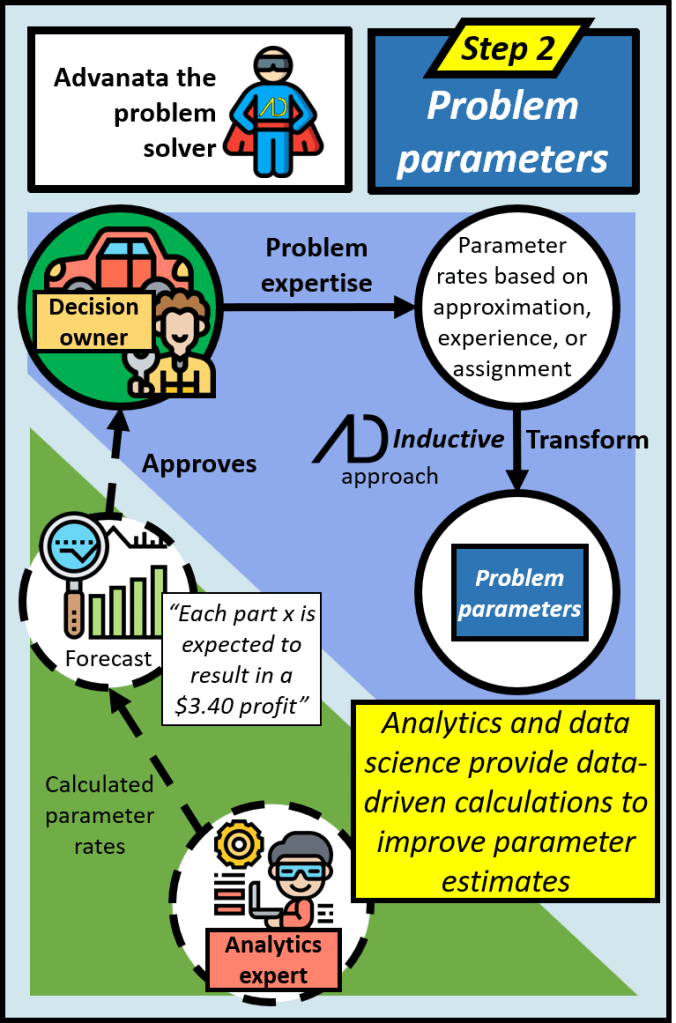
The decision owner has the problem expertise to provide parameter rates based on approximation, experience, or assignment. The inductive approach then transforms this into problem parameters. Analytics and data science can provide data driven calculations to improve parameter estimates such as each part expected to result in a $3.40 profit from which the decision owner can decide whether to update their problem parameters.

Having actual real numbers is essential for decision optimization, and this is typically provided by reporting experts. It also enables the optimized solution to be updated as operational conditions change over time.
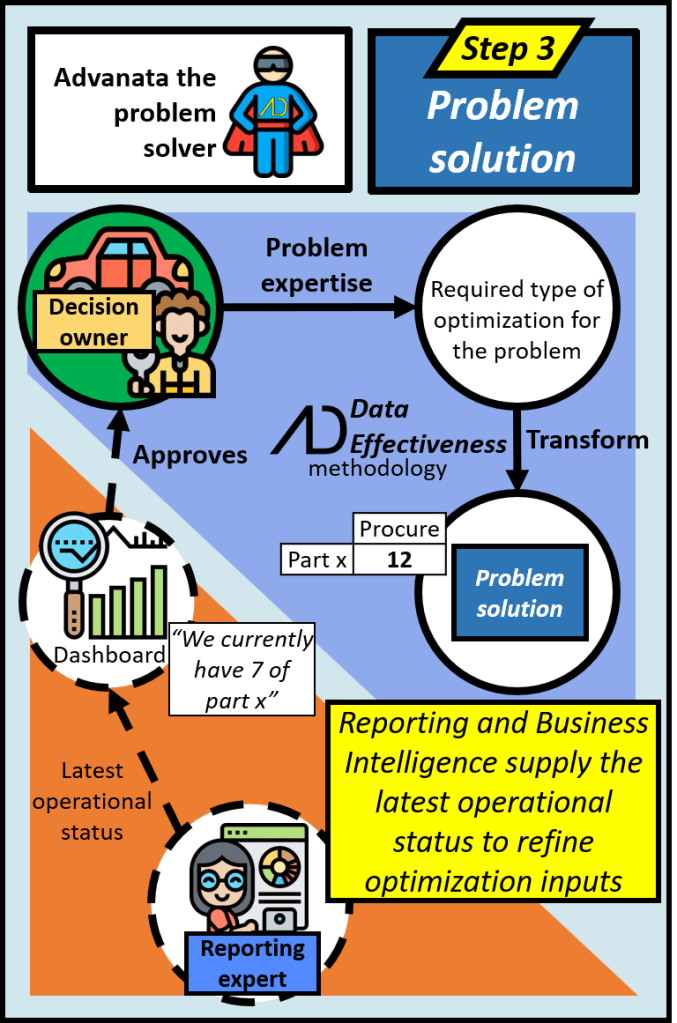
The decision owner has the problem expertise to decide on the required type of optimization for their problem which is then transformed by the data effectiveness methodology into the problem solution such as procure 12 items of part x. Reporting and busines intelligence supply the latest operational status to refine optimization inputs such as we currently have 7 of part x. This can be used by the decision owner to update their problem optimization requirements as needed.

Decision Support Isn’t Enough

Business decision problems require optimal operational actions, which decision optimization delivers. Partial solutions are insufficient; decision owners need complete, consistent outputs that avoid subjective interpretation or mixed assumptions across methods. Traditional approaches are incomplete on their own but when combined with Advanata’s end-to-end approach can allow for solving more complex problems.

One quick poll question (3 seconds):
I’d really value your input.

Sign up for early access to articles, delivered every two weeks. Please check your spam folder for the confirmation email.

Ready to see Advanata in action? Explore more resources, read related articles, and access the full application at advanata.com.

Looking for a personalized walkthrough or decision intelligence consulting? Contact info@advanata.com to get application access, schedule a demo, or discuss your decision optimization challenges.

Leave a comment