

Separating the Help from the Hype

2 minutes

New technologies are constantly emerging, each promising to change the world. But between the hype and reality, how can these technologies actually help? By reducing them to their basic operations, we can see what they really offer, where they fall short, and how to use them effectively.

The Hype and the Reality

We will focus only on content-based technologies, which work and operate exclusively with content. This creates four distinct categories that encompass all these technologies.
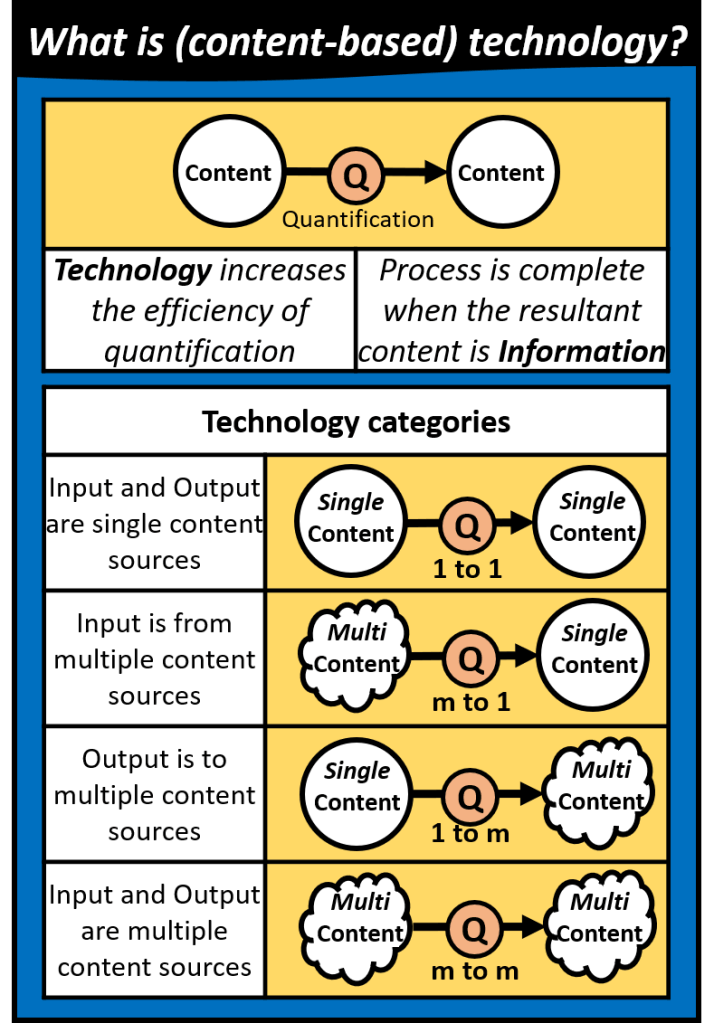
Content based technology transforms content into content through quantification. Technology increases the efficiency of quantification. The transformation process is complete when the resultant content is information. There are four technology categories: input and output are single content sources, input is from multiple sources, output is to multiple sources, and both input and output are multiple sources.

Sample Content-Based Technologies

Computers, in their many forms, are the content technology that started it all. On their own, they take content from a single source and, when useful, produce information for the user.
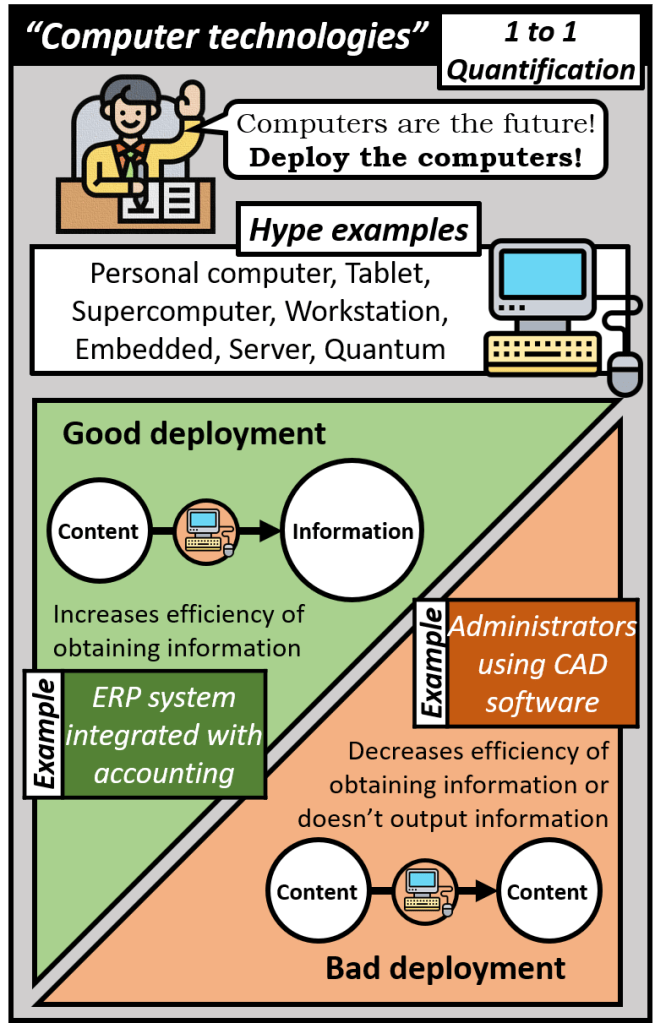
Computers are a type of 1 to 1 quantification technologies. With hype examples such as personal computers, tablets, supercomputers, workstations, embedded, server, and quantum. A good deployment results in information and increase the efficiency of obtaining information such as an ERP system integrated with accounting. A bad deployment decreases the efficiency of obtaining information or doesn't output information at all such as administrators using CAD software.

Internet technologies greatly extend the reach of computers. They can deliver information quickly and efficiently to multiple sources, making them a game changer when they provide what users actually need.
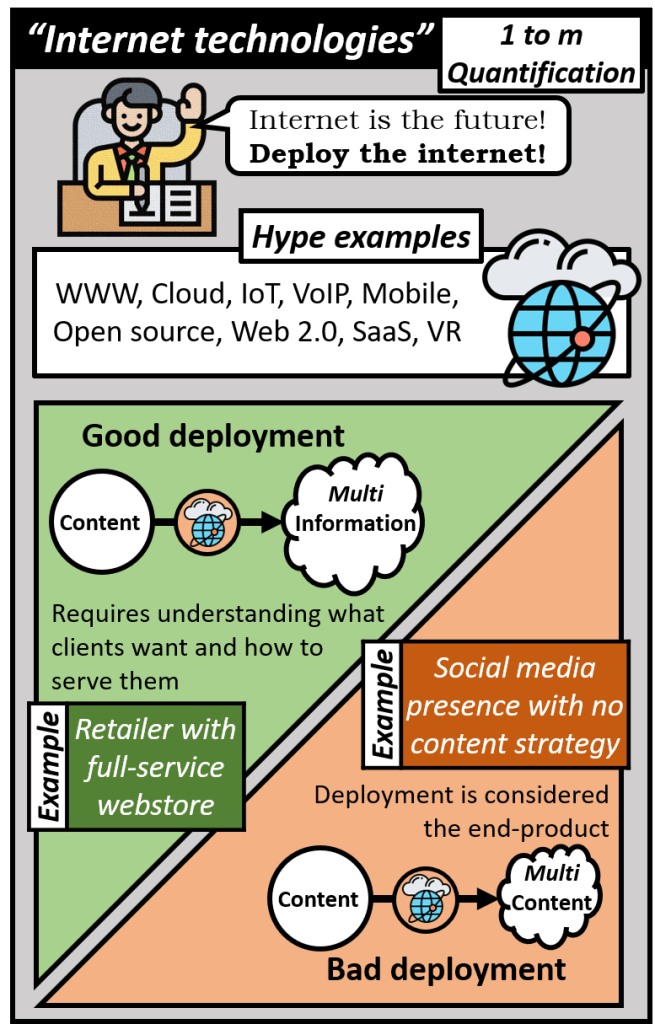
Internet is a type of 1 to many quantification with hype examples such as www, cloud, IoT, VoIP, Mobile, Open source, web 2.0, SaaS, and VR. A good deployment will result in multi information and requires understanding what clients want and how to serve them such as a retailer with a full service webstore. A bad deployment is when the technology itself is the end product such as social media presence with no content strategy

Analytics can work with a single content source, but multiple sources can greatly expand their capabilities. Their Achilles’ heel is the narrow range of useful outputs, often producing more content rather than actionable information.
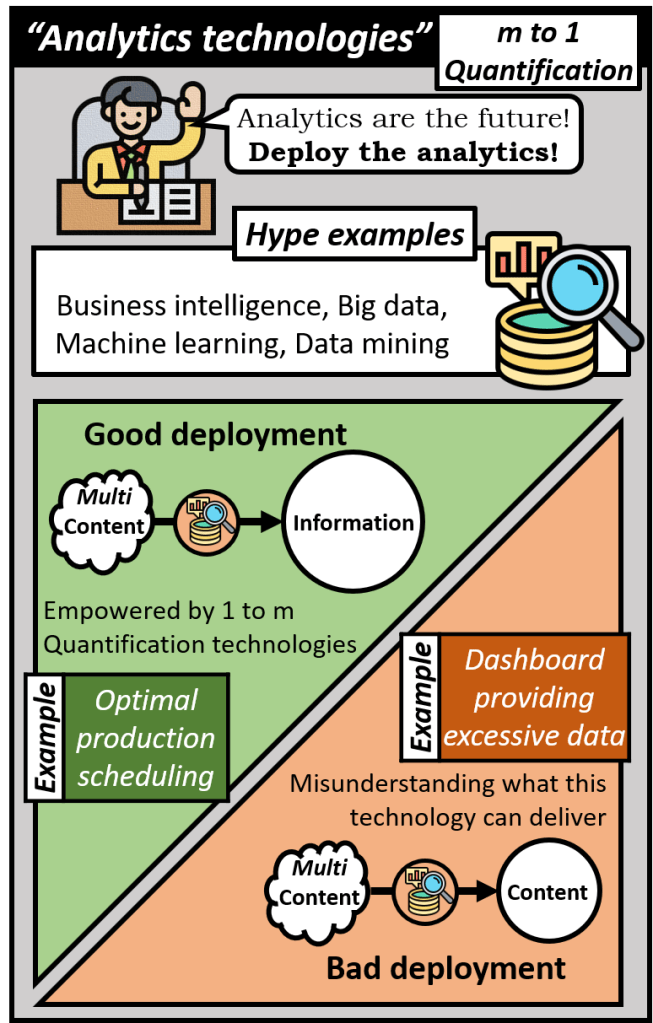
Analytics are a form of many to 1 quantification technology where some hype examples include business intelligence, big data, machine learning, and data mining. A good deployment is empowered by 1 to many quantifcation technologies and results in formation such as optimal production scheduling whereas a bad deployment is a result of misunderstanding what the technology can delivered  such as a bloated dashboard where the resultant output is just more content and not information.

Artificial intelligence, in its contemporary definition, is often billed as the biggest game changer of all. Reducing it to its basic operation reveals what it actually does. Like analytics, its outputs are probabilistic and require consideration of this uncertainty, but its much broader utility enables it to generate useful information for far more users.
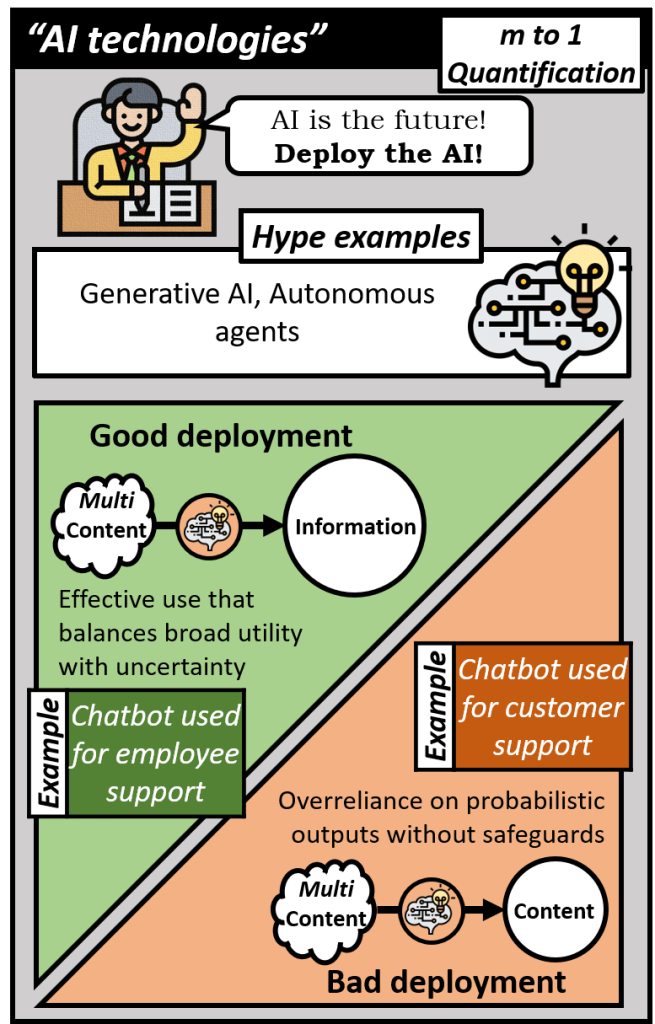
AI, namely GAI, is a many to 1 quantification technology and hype examples include, generative ai and autonomous agents. An example of a good deployment takes into consideration the broad utility and limitations of the technology such as a chatbot for employee support whereas a bad deployment is one where there is an overreliance on probabilistic outputs without safeguards such as a chatbot used for customer support.

One of the most hyped yet disappointing technologies is blockchain. Paradoxically, it is not a technology in the strict sense, but an “anti-technology”, which may explain why its utility has remained elusive.
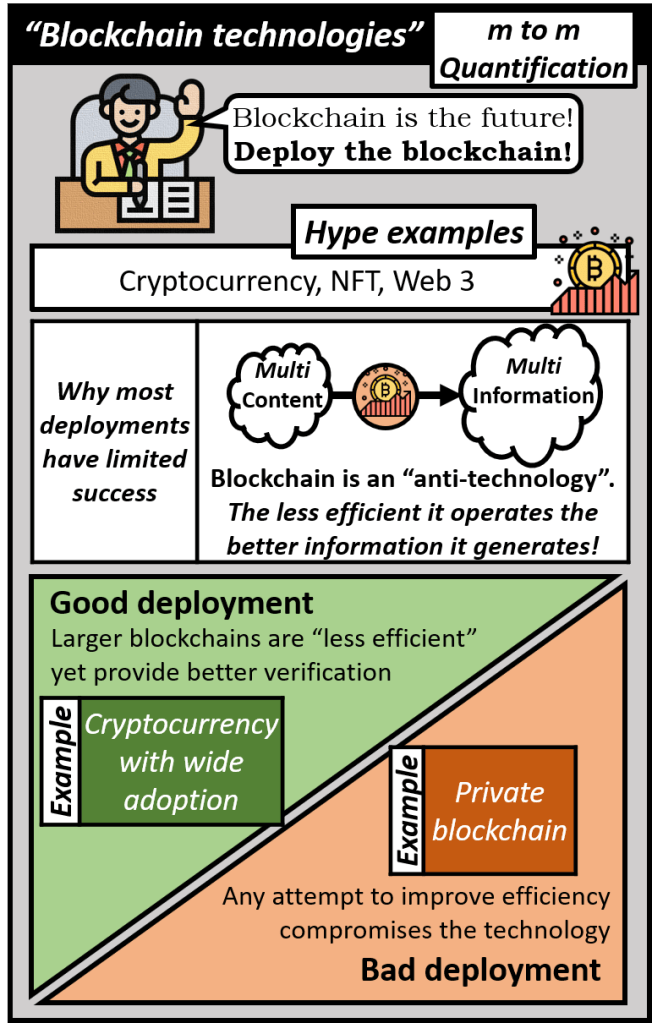
Blockchain is a many to many quantification technology with hype examples such as cryptocurrencies, NFT, and web 3. Most deployments are actually of limited success due to the fact that blockchain is in reality an anti-technology, the less efficient it operates the better information it generates. A good deployment utilizes this inefficiency such as larger blockchains to provide better verification such as in the case of a cryptocurrency with wide adoption. Any attempt to make this deployment more efficient compromises the technology and is a bad deployment such as private blockchains.

Advanata Technology

Advanata takes information as both input and output and cannot produce an output unless the underlying quantification is properly structured. Unlike many other technologies, it produces either useful output for the user or nothing at all.
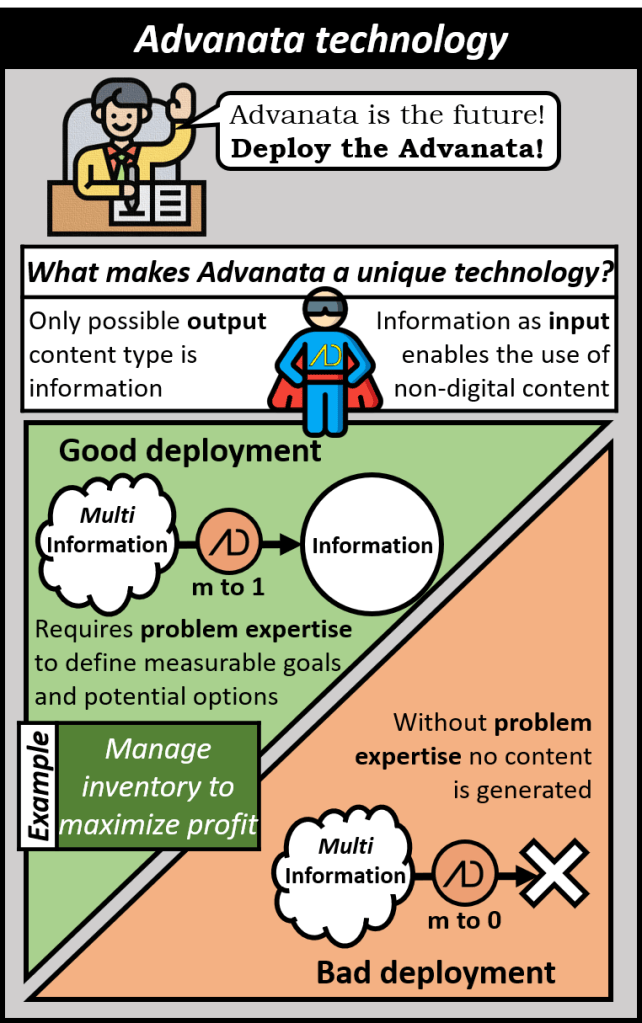
Advanata is unique technology in that the only possible output is information and it also uses information as its input thus allowing the use of non-digital content. A good deployment requires problem expertise to define measurable goals and potential options such as managing inventory to maximize profit. A bad deployment will result in no output such as when no problem expertise exists.

The immediate Advanata application is optimizing which new technologies to deploy. This simple but essential decision determines what to fully investigate, partially investigate, or ignore as new technologies emerge.
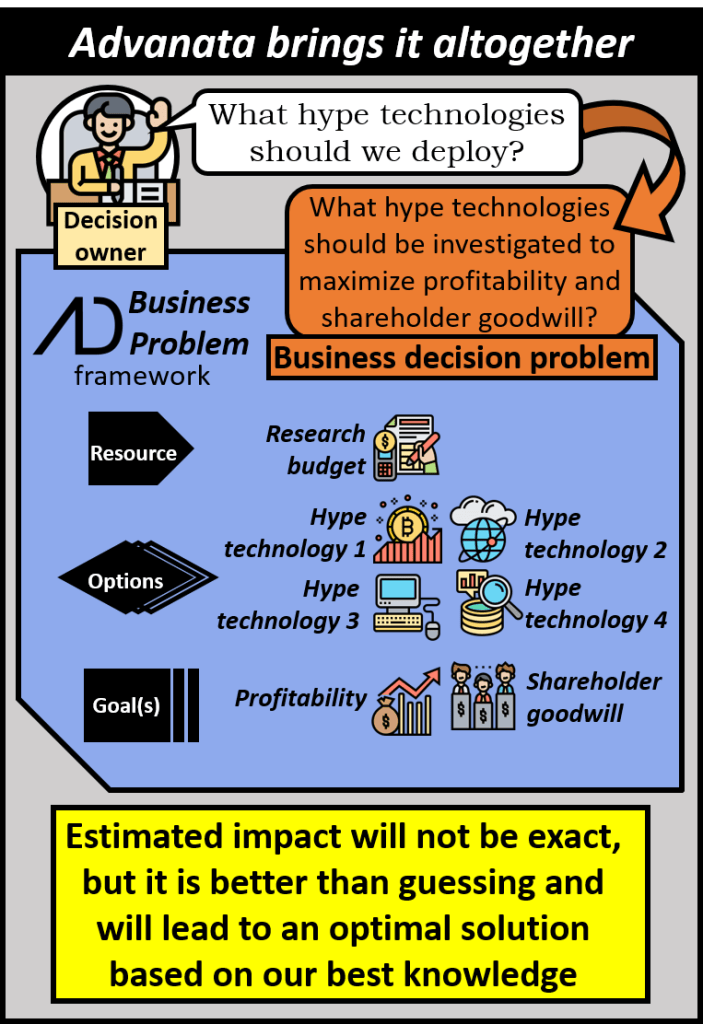
A decision owner may ask what hype technologies to deploy. This can be formatted into a business decision problem: What hype technologies should be investigated to maximize profitability and shareholder goodwill which can be easily mapped to the business problem framework. The resource is the research budget, the options are the different hype technologies under consideration, and the goals are profitability and shareholder goodwill. The estimated impact of technology deployment on the goals will not be exact, but it is better than guessing and will lead to an optimal solution based on our best knowledge.

Beyond the Hype

Technology deployment is risky and expensive. Looking beyond the hype and reducing content-based technologies to their basic operations helps clarify what they can actually deliver. Advanata is distinct in that it is designed to optimally solve business decision problems and deliver the precise information decision owners need, and nothing else.

One quick poll question (3 seconds):
I’d really value your input.

Sign up for early access to articles, delivered every two weeks. Please check your spam folder for the confirmation email.

Ready to see Advanata in action? Explore more resources, read related articles, and access the full application at advanata.com.

Looking for a personalized walkthrough or decision intelligence consulting? Contact info@advanata.com to get application access, schedule a demo, or discuss your decision optimization challenges.

One response to “Separating the Help from the Hype”

  1. Adnan Avatar
    Adnan

     Well positioned. Why do I need to log on again to comment

    Like

Leave a comment