
Business Problems: What are they?

1–2 minutes

Business problems are about finding the best actions to help customers reach their goals. Whether individuals or organizations, customers want real solutions, not additional analytics work.
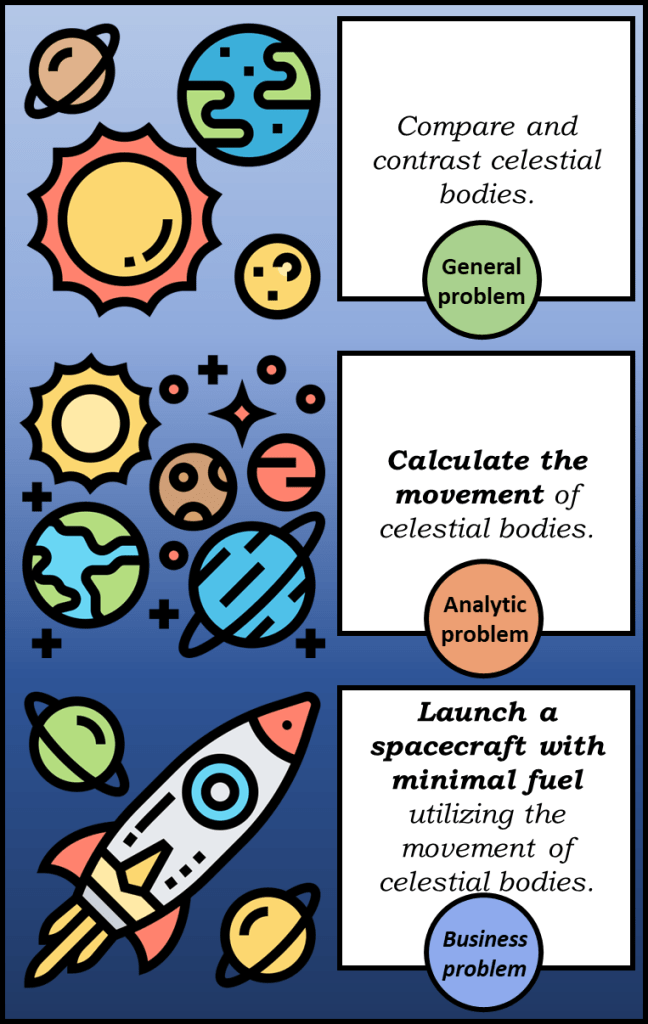
Compare and contrast celestial bodies is a general problem. Calculating the movement of celestial bodies is an analytic problem. Launching a spacecraft with minimal fuel utilizing the movement of celestial bodies is a business problem.

Let’s start from the very beginning. General problems cover all types of problems and can often be converted into Analytic problems through quantification.
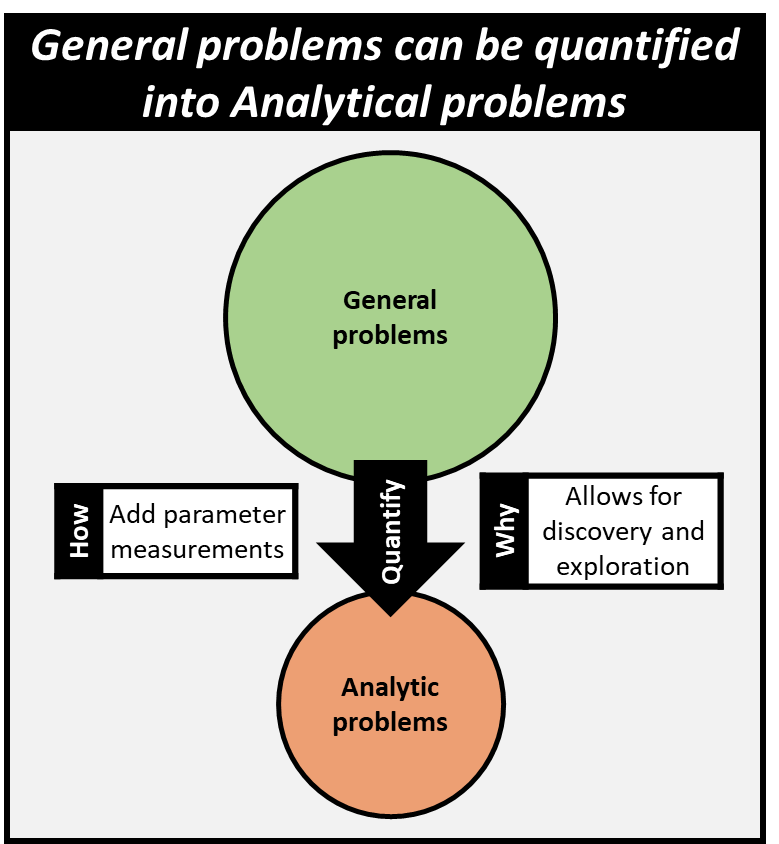
general problems can be quantified into analytical problems by adding parameter measurements which allows for problem discovery and exploration.

Before examining the next level of problem transformation, let’s start with the customer’s needs. As noted, customers are focused on their own activities and desire optimal actions to solve their problems, not additional analytics research.

To take the right actions, customers first need to define their problem clearly. Surprisingly, this only requires identifying three key elements: Goals, Options, and Resources. If these components exist and can be identified, then we have a Business problem, and the complete structure can be easily entered into Advanata. No intermediaries or complex coding are required; all it takes is simple harnessing of human intelligence.
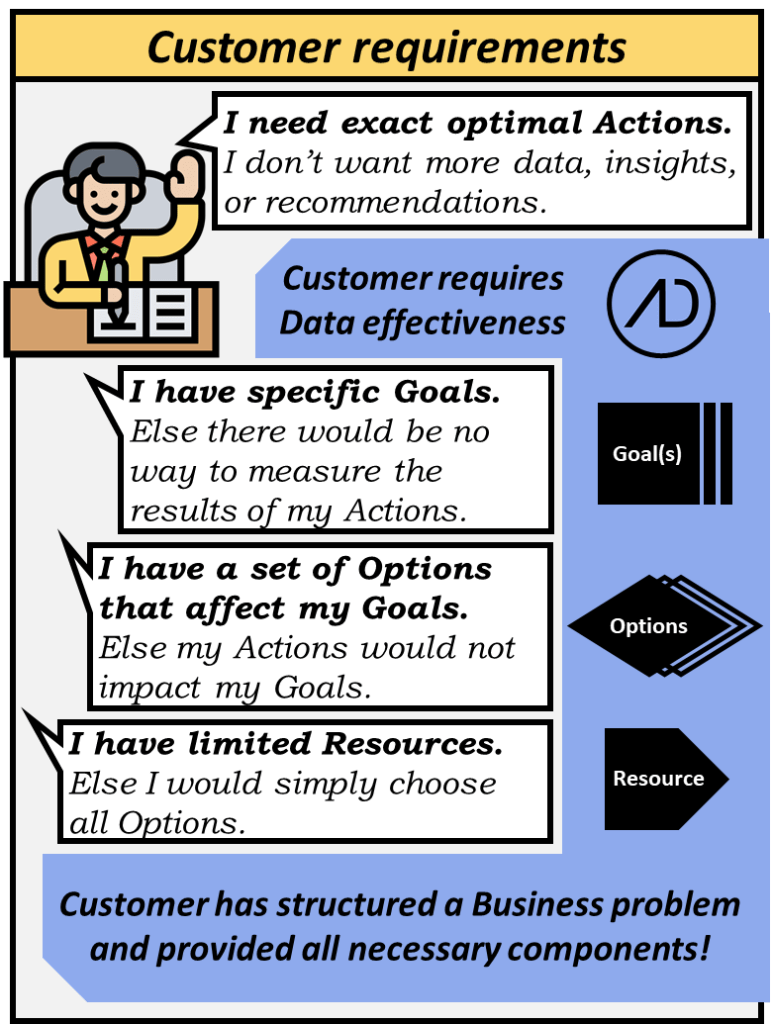
Customer requirements lead to the creation and definition of business problems. Customer wants exact optimal actions, not more data, insights or recommendations thus requiring data effectiveness. Customer has specific goals else there would be no way to measure the results of their actions. Customer has options that affect their goals, else their actions would have no impact on their goals. Customer has limited resources; else they would simply choose all options. By having these components, the customer has fully structured a business problem.

Now we can see how the last step of converting an Analytic problem into a Business problem is performed by adding structure to the problem.
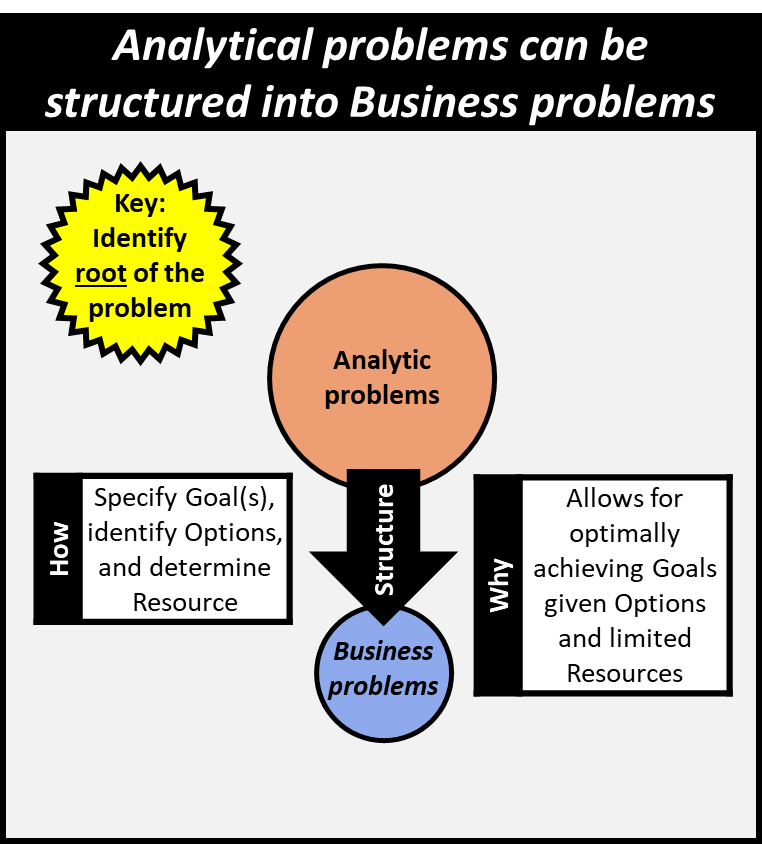
analytical problems can be structured into business problems by specifying goal(s), identifying options and determining the resource. This allows for optimally achieving goals given options and limited resources. The key to performing this conversion is identifying the root of the problem.

Taking a step back, if a customer needs to take actions, they also expect resultant effects on their Goals and must therefore take the best actions in order to obtain the best effects. This action-and-effect dynamic is solved using Data effectiveness and the entire sequence is a Business problem.
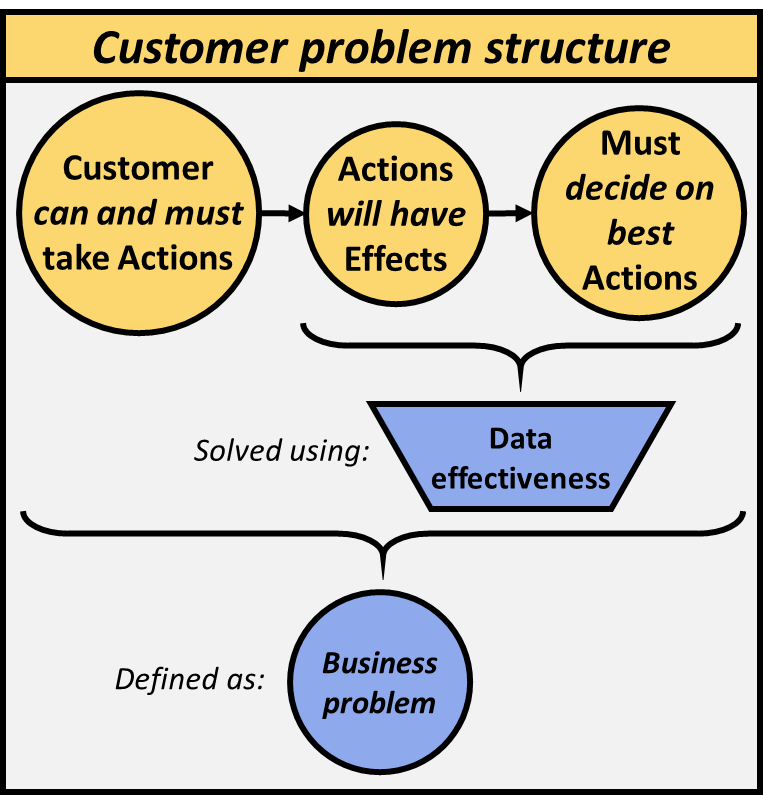
High level view of customer problem structure resulting in a business problem solved using data effectiveness. Data effectiveness consists of Actions having effects along with deciding on the best actions. Business problem consists of a customer that can and must take actions along with the aforementioned data effectiveness components.

To bring this into practice, consider the following management consultancy style problem. Quantifying the problem helps significantly, as it allows us to measure the costs and benefits of process reengineering. But once the problem is structured as a Business problem, we can go beyond measurement to being able to automatically determine the optimal course of action.
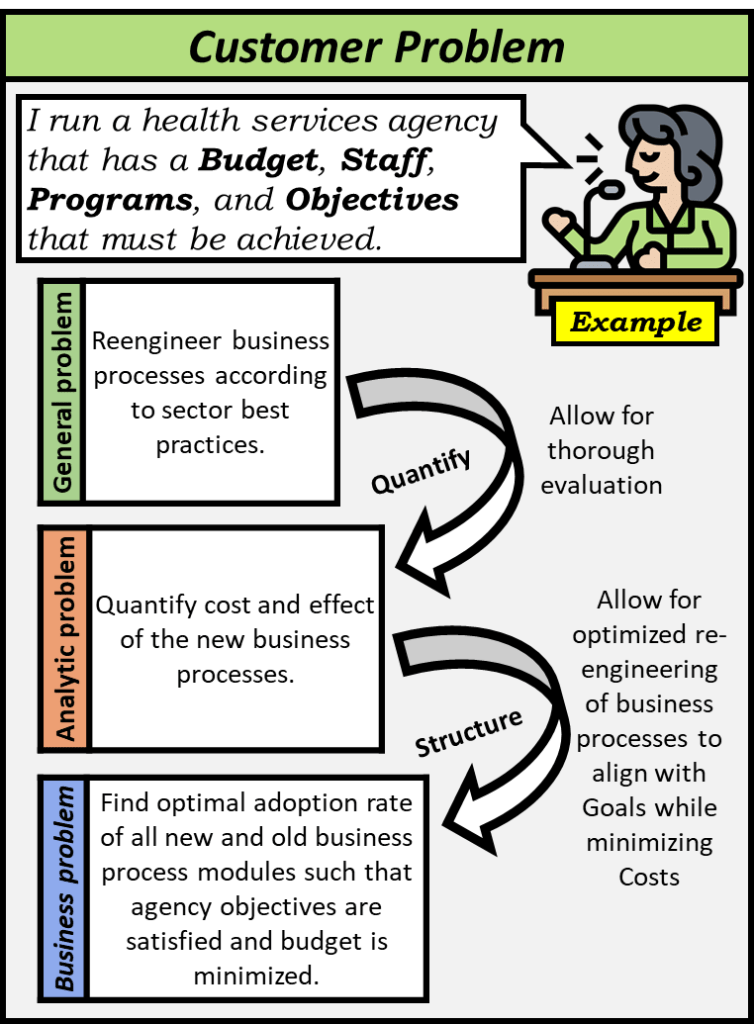
typical customer problem demonstrating how a general problem can be transformed into an analytical problem (allowing for thorough evaluation) and finally a business problem (allowing for optimized re-engineering of business processes to align with goals while minimizing costs)

Business problems are a structured form of Analytic problems that produce actionable outputs thus aligning them with customer requirements. The vast majority of real-world problems are in fact Business problems. Advanata is built to solve these problems with maximum efficiency; customers easily input the structural components, fine-tune the parameters, and the optimal solution is automatically generated.

Visit advanata.com for access to application, additional information, and related articles.

8 responses to “Business Problems: What are they?”

  1. […] and subject experts are best equipped to identify causation, while careful problem specification keeps analytics focused on the problem at […]

    Like

  2. How to Avoid Unreliable Business Forecasts Avatar

    […] discussions often default to a broad study of the current state projected into the future. For business problems, it is worth stepping back and asking why such deep and difficult forecasting is even […]

    Like

  3. […] are many approaches to solving business problems. This discussion will highlight which approach delivers superior results and how Advanata makes […]

    Like

  4. […] decision owner must have sufficient problem expertise to structure the business decision problem. Subject matter expertise can enhance this structure by adding options that expand the range of […]

    Like

  5. […] decomposition can be challenging. The business problem framework was developed after years of research and provides a core structure that captures the essential […]

    Like

  6. […] business problem framework requires all three components to be fully defined before the solution process can begin. This […]

    Like

  7. […] business problem framework transforms experience into expertise using a structured approach specifically tailored to solving […]

    Like

  8. […] being solved. Some problems can benefit greatly from more data, while others, including many business decision problems, can actually suffer from it. Therefore, the goal should not be to gather more data, but to […]

    Like

Leave a Reply