
Churning Answers into Better Business Decisions

2 minutes

Finding answers to business problems is becoming easier than ever. The real challenge is choosing the best course of action from the many possible answers. In this article, we’ll compare good and bad approaches to business decision making and see how Advanata combines the best ideas into a simple yet powerful platform for making optimal decisions.

Bad Approaches to Decision Making

There are many ways to make poor business decisions, from blindly following data patterns to letting the boss assert their authority or relying on group consensus to disperse accountability. While these approaches are common, there are far more effective ways to make sound decisions.
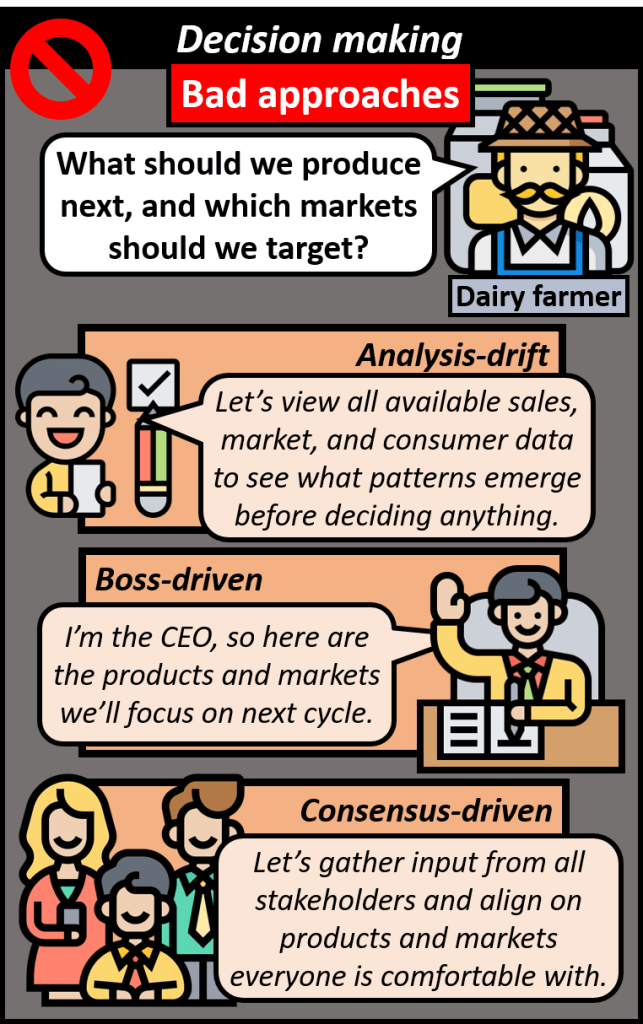
A dairy farmer asks what should we produce next, and which markets should we target? Analysis drift is where we review all available sales, market, and consumer data to see what patterns emerge before deciding anything. Boss driven is letting the boss decide on the products and markets to focus on in the next cycle. Consensus driven is where input is gathered from all stakeholders and alignment is reached on products and markets everyone is comfortable with, These are all bad decision making approaches.

Good Approaches to Decision Making

Effective decisions require the right balance of quantitative and qualitative input organized within a sound methodology.
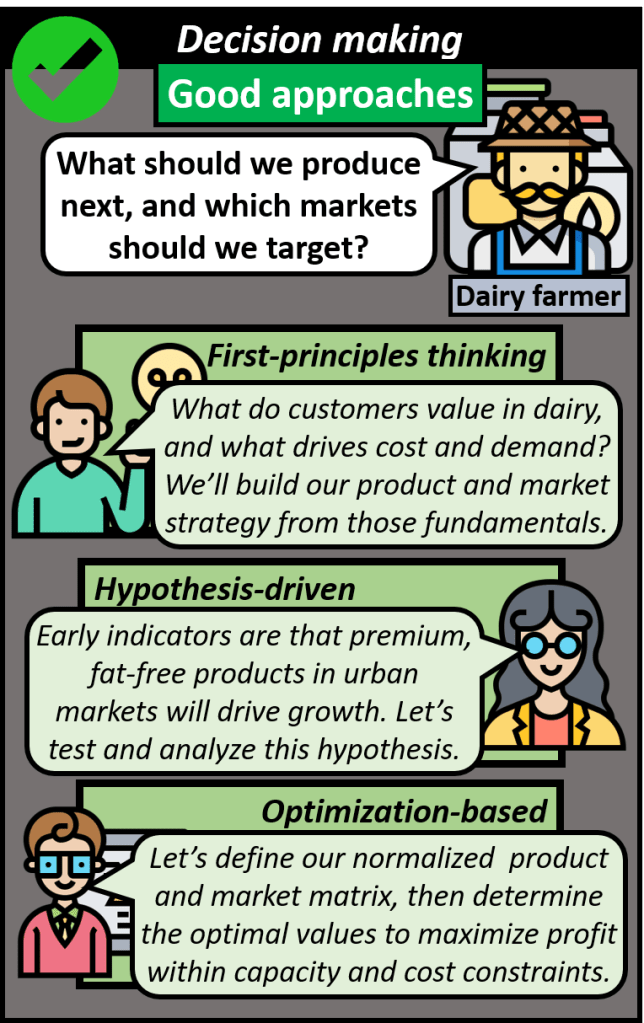
A dairy farmer asks what should we produce next, and which markets should we target? First principles thinking asks what do customers value in dairy, and what drives cost and demand then builds the product and market strategy from those fundamentals. Hupothesis driven starts by looking at the early indicators driving growth such premium fat-free products in urban markets then tests and analyzes this hypothesis. Optimization based starts by defining the normalized product and market matrix then determines the optimal values to maximize profit within capacity and cost constraints. All of these are good approaches to decision making.

Problem decomposition can be challenging. The business problem framework was developed after years of research and provides a core structure that captures the essential components needed to represent the vast majority of real-world business decision problems.
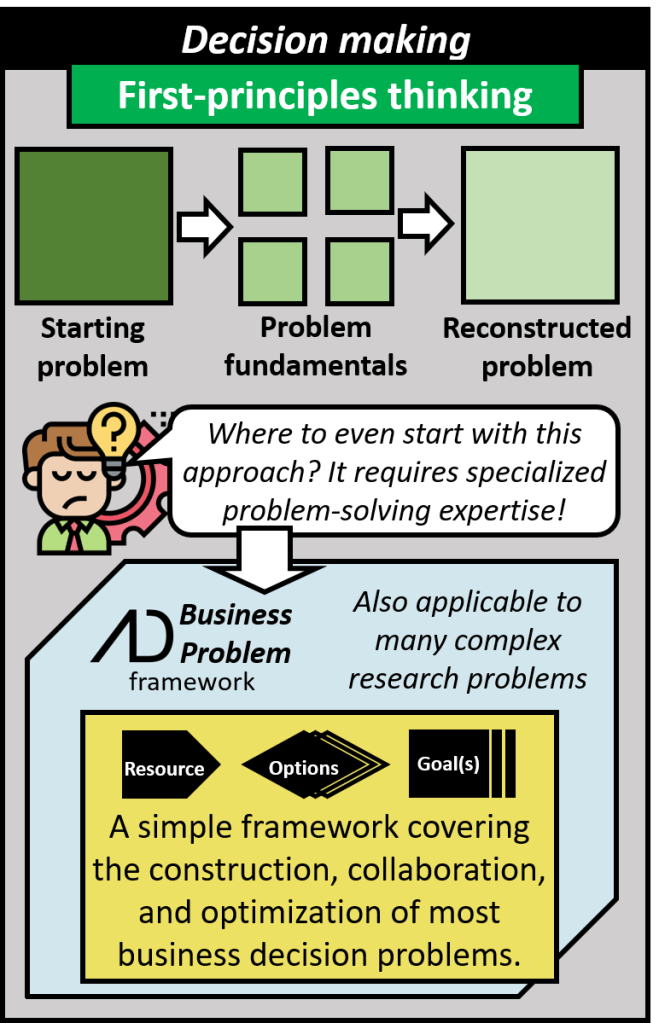
First principles thinking takes the starting problem breaks it down into its fundamentals then reconstructs the problem. This often requires very specialized problem solving expertise that is difficult to acquire. The business problem framework is a simple framework that covers the construction, collaboration, and optimization of most business decision problems and is also applicable to many research problems.

The inductive approach structures the problem to make the best use of each participant’s expertise while keeping the decision owner in control throughout the process.
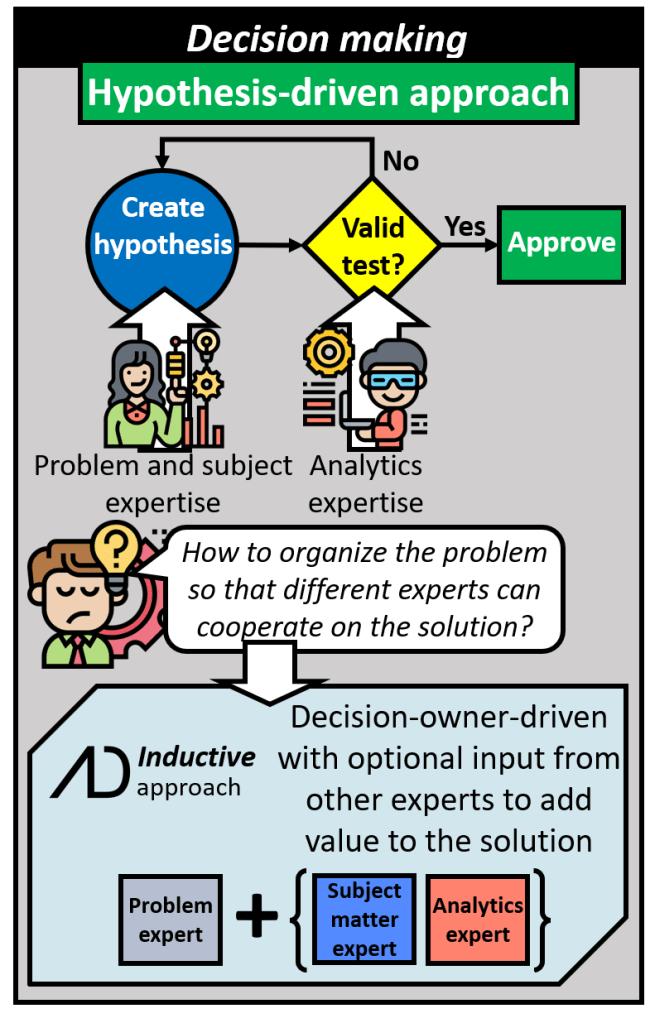
The hypothesis driven approach starts with a created hypothesis that is tested and if validated is approved. This requires the cooperation of participants with different skill sets and the problem must be organized to allow for such cooperation. The inductive approach is decision owner driven with optional input from other experts to add value to the solution.

Mathematical optimization is often limited by the complexity of problem modeling. The Data Effectiveness methodology removes this barrier by allowing problems to be defined with an intuitive business framework instead of a specialized optimization model.
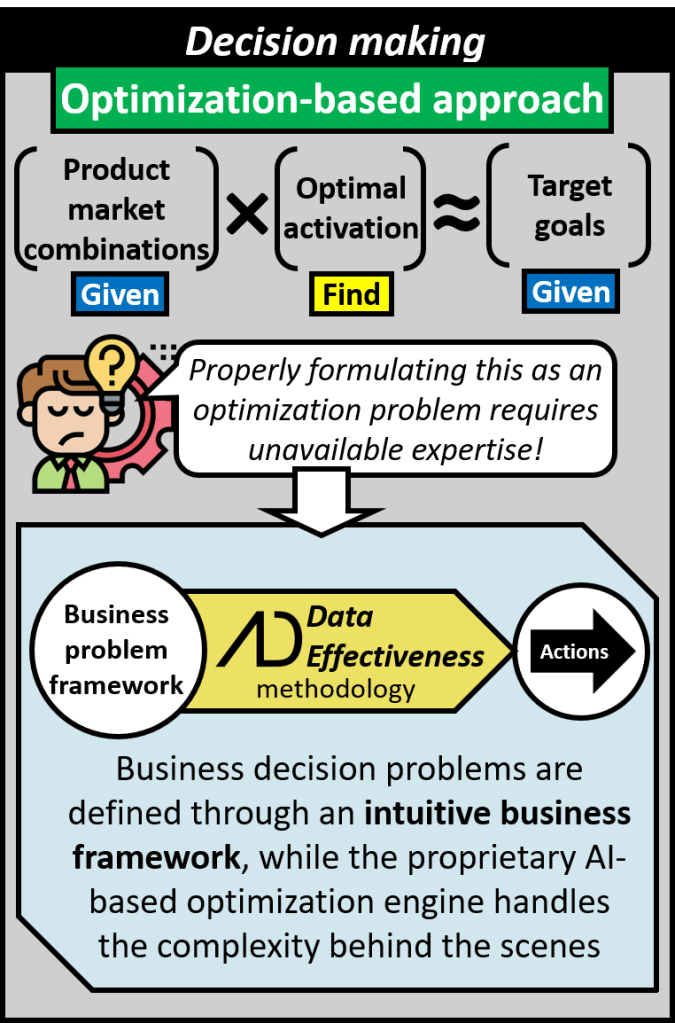
The optimization based approach is given the product market combination matrix and the desired goals and fids the optimal activation. This requires expertise to formulate the problem and then solve it. The data effectiveness methodology accepts problems intuitively defined by the business problem framework, while the AI-based optimization engine handles the complexity behind the scenes.

Advanata Approach to Decision Making

Just three simple steps are all it takes for the decision owner to reach an optimal decision with optional support from other experts to further enhance the solution.
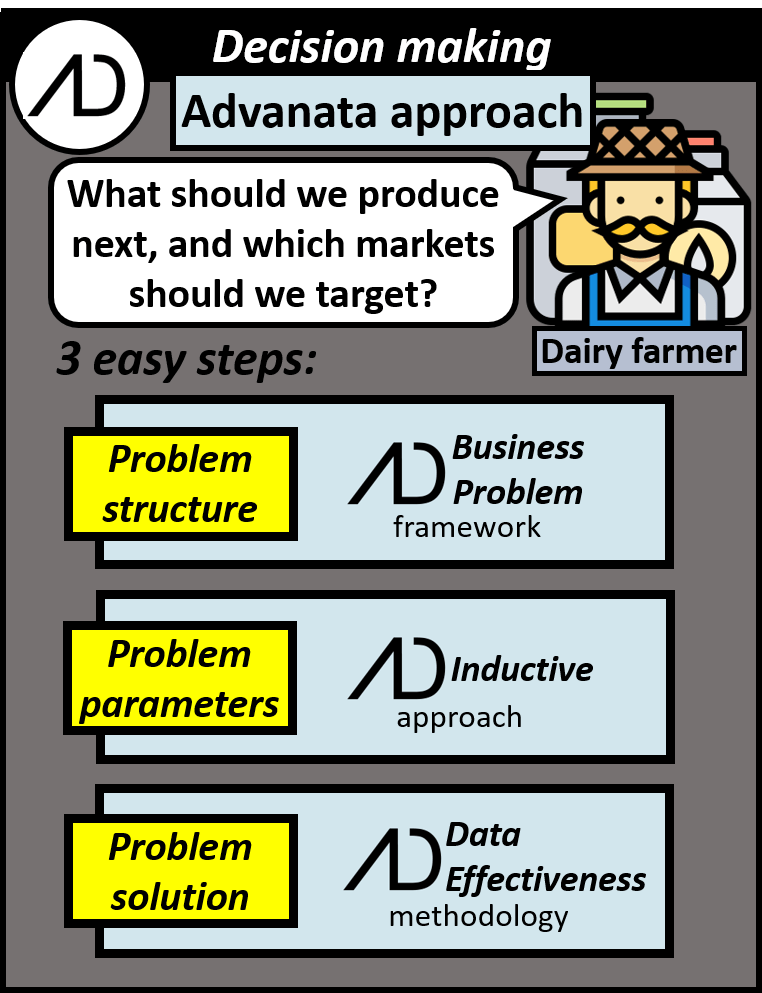
A dairy farmer asks what should we produce next and which markets should we target. Adavanata answers this in three easy steps. Problem structure is defined using the business problem framework. Problem parameters are defined using the inductive approach. Finally, the problem solution is obtained using the data effectiveness methodology.

Looking more closely at this dairy farming example, we can see that solving the problem simply requires the decision owner to clearly define what needs to be achieved and then follow the process to arrive at precise, optimal actions.
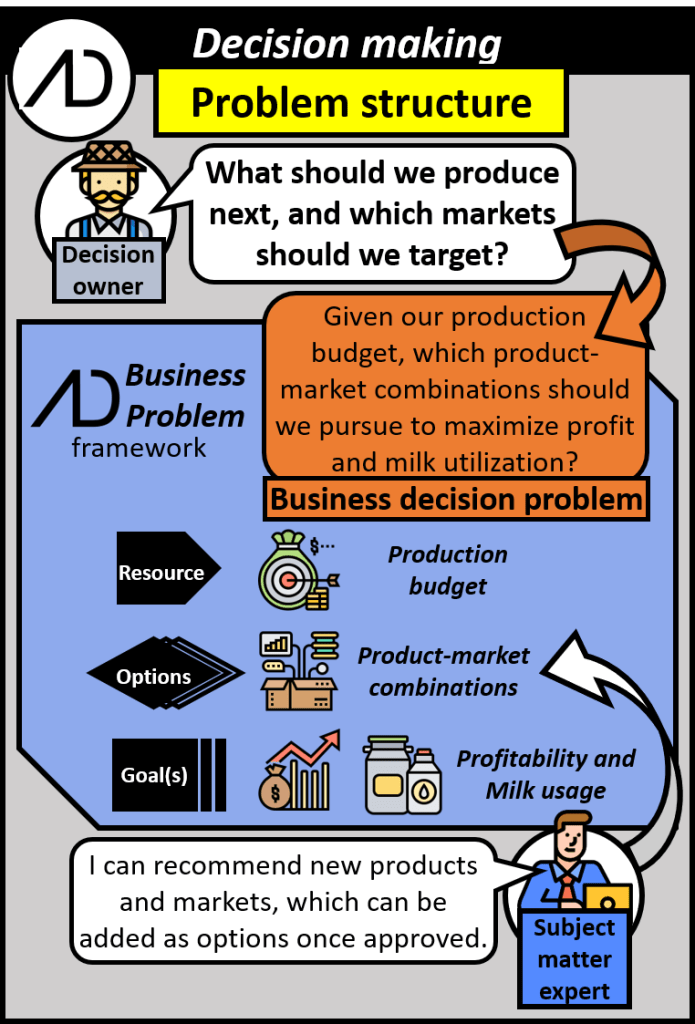
The dairy farmer's question of what should we produce next and which markets should we target. Is really a business decision problem that asks given our production budget, which product-market combinations should we pursue to maximize profit and milk utilization. Production budget is the resource, Product-market combinations are the options. Profitability and milk usage are the goals. A subject matter expert can also suggest additional options that can be reviewed and approved by the decision owner.
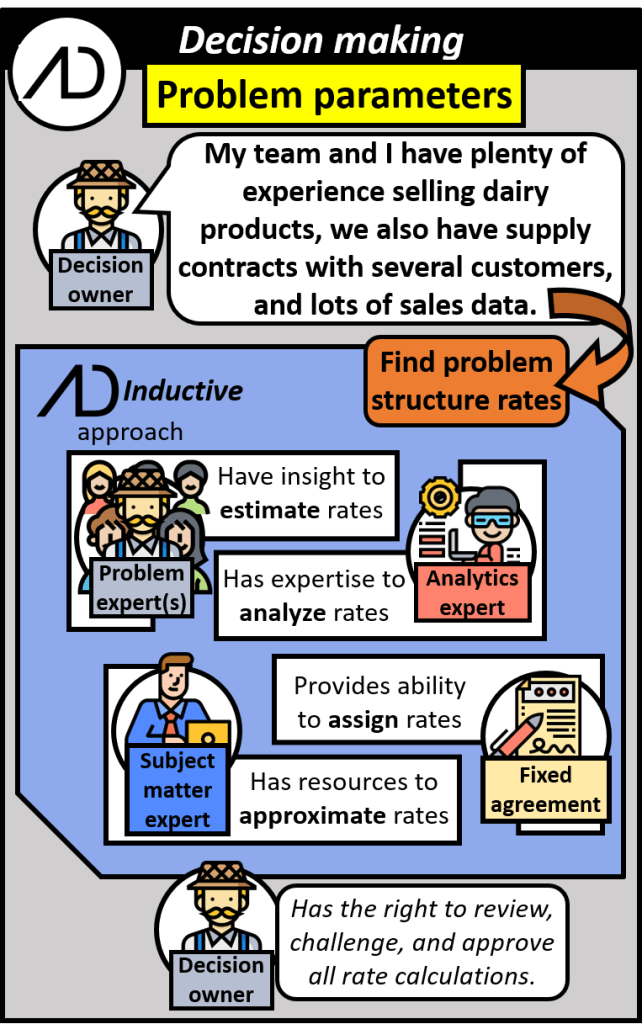
The dairy farmer and their team have experience selling dairy products, supply contracts with customers, and plenty of sales data this can be methodically used to find problem structure rates. Problem experts have insight to estimate rates, analytics experts have expertise to analyze rates, subject matter experts have resources to approximate rates, and fixed agreements can assign rates. The decision owner has the right to review and approve all these calculation results.
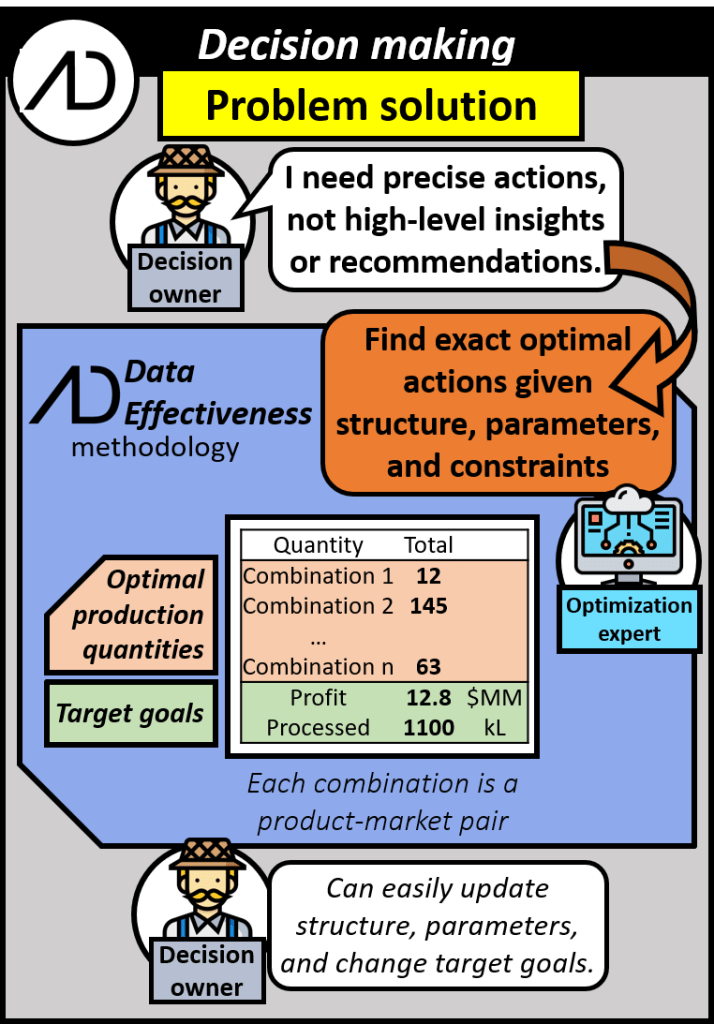
The dairy farmer wants precise actions not high level insights or recommendations. This translates into requiring exact optimal actions given the problem structure, parameters, and constraints. This will result in exact optimal production quantities for the different product market combinations and exact values for the target goals. The decision owner can easily update the structure, parameters and change the goals as desired.

Importance of Decision Making

What matters most is not finding more answers but consistently turning available answers into better business decisions as conditions change. This requires a flexible platform that can adapt while still producing clear, optimal actions. Advanata makes this possible by structuring business decision problems through an intuitive business framework and converting them into optimal operational actions without the need for specialized expertise or advanced solution methods.

One quick poll question (3 seconds):
I’d really value your input.

Sign up for early access to articles, delivered every two weeks. Please check your spam folder for the confirmation email.

Ready to see Advanata in action? Explore more resources, read related articles, and access the full application at advanata.com.

Looking for a personalized walkthrough or decision intelligence consulting? Contact info@advanata.com to get application access, schedule a demo, or discuss your decision optimization challenges.

Leave a comment