

Why Analytics Fails to Land the Right Decision

2 minutes

So much has been promised by analytics. With unprecedented data availability, quantitative analysis was expected to transform how businesses solve problems and usher in a new era of optimal decision-making. Yet the reality has fallen short of those expectations. In this article, we examine why and how Advanata addresses the underlying challenges.

Problem Solving Process

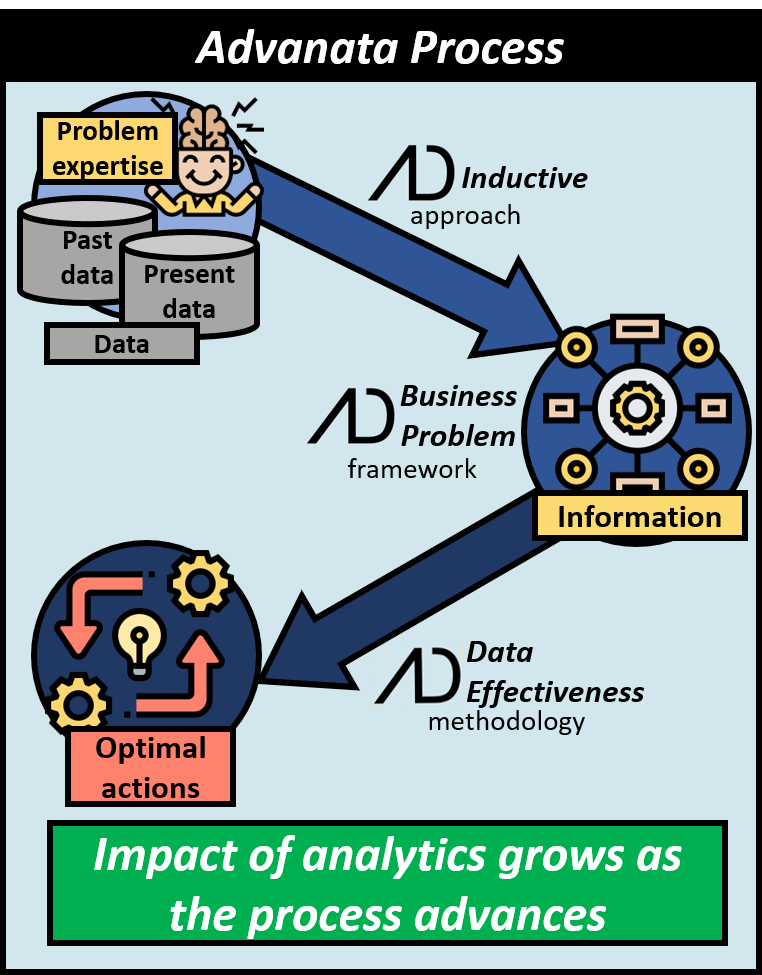
The conventional approach front-loads the problem-solving process with extensive analytics, leaving customers to sift through the results and piece together a workable solution. The outcome is often only a fraction of what analytics can actually achieve. Advanata is designed to maximize the value of analytics by delivering optimal actions, not just extensive recommendations.
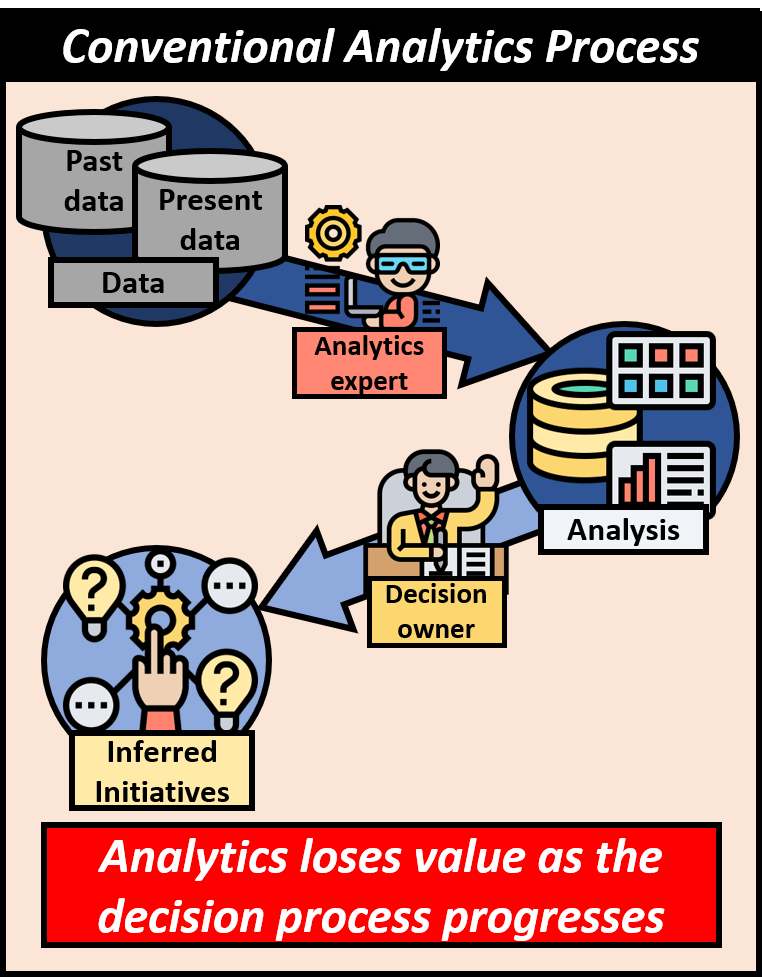
Conventional analytics process starts with a collection of past and present data that is processed by an analytics expert into analysis which is then processed by the decision owner into inferred initiatives. Analytics loses value as the decision processes progresses.
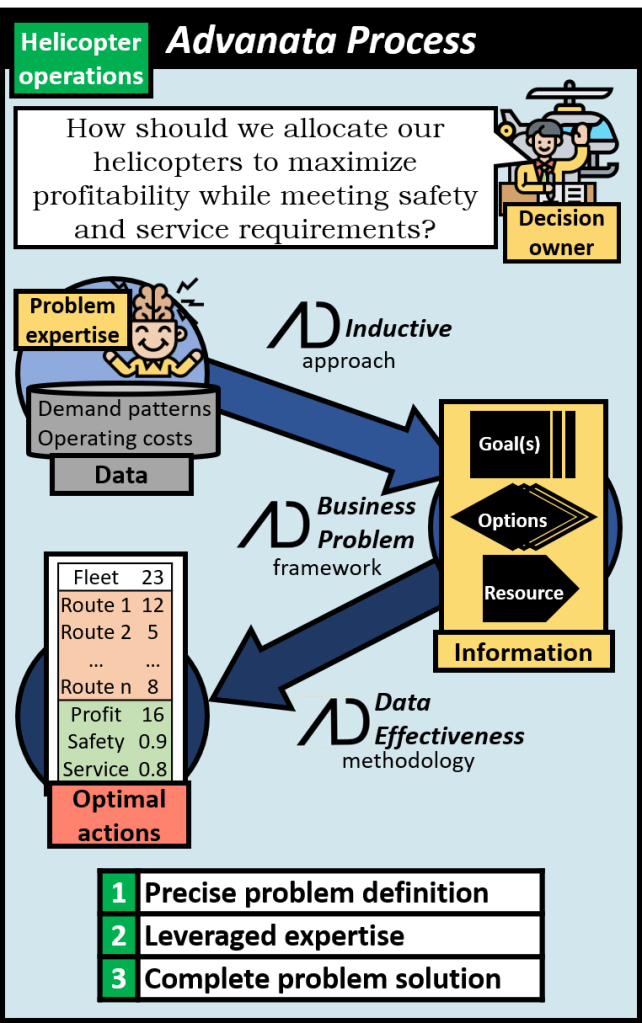
Advanata process starts with past and present data and problem expertise which are processed using the inductive approach into information held within the business problem framework which is then processed by the data effectiveness methodology into optimal actions. The impact of analytics grows as the process advances.

Taking a Closer Look at the Issues

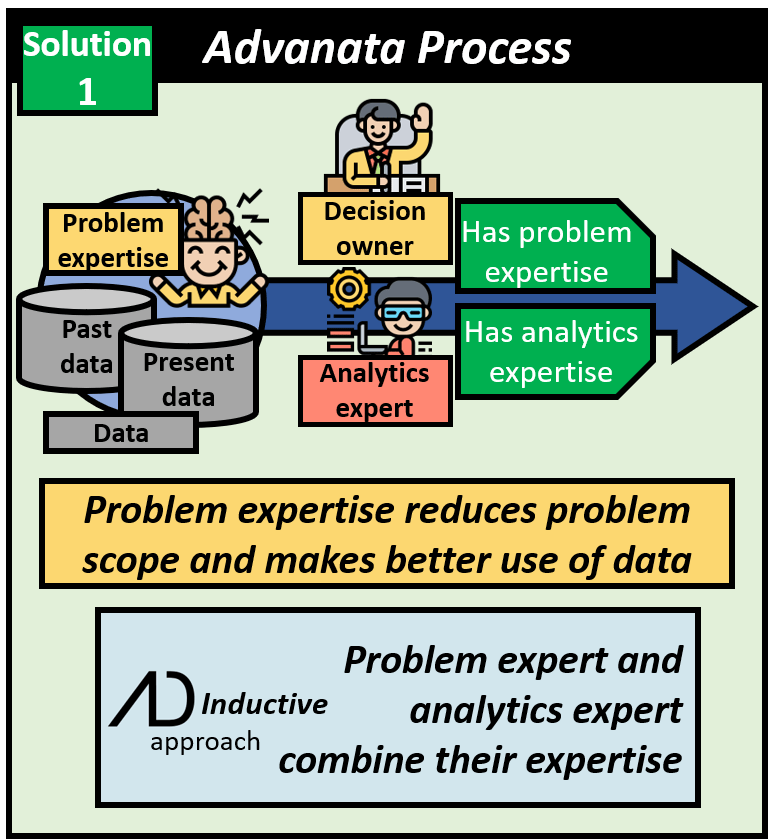
Issues begin when analytics experts are expected to define and structure the business decision problem itself. Decision owners possess the necessary business knowledge, and when properly aligned with analytics experts, they reduce the scope of analysis and help ensure the solution fits the problem.
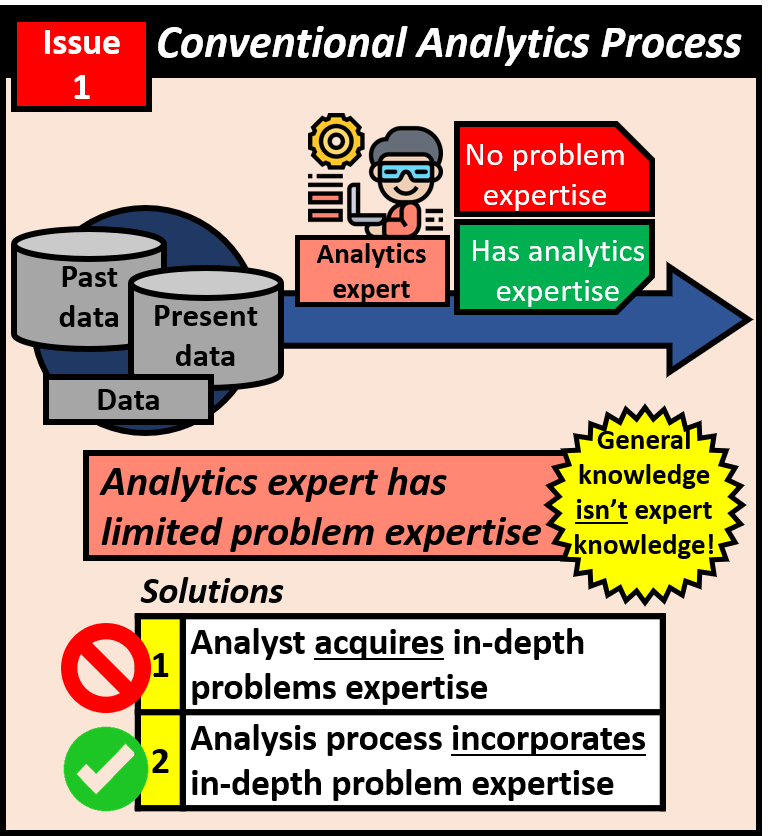
Issue 1 with the conventional analytics process is that the analytics expert doesn't have problem expertise when processing the data. General knowledge is of course not expert knowledge. A bad solution is for the analyst to acquire in depth problem expertise while a better solution is that the process incorporates in depth problem expertise.
Solution to issue 1 with the Advanata process is to add problem expertise provided by the decision owner along with data. Problem expertise reduces problems scope and makes better use of available data. This is the core of the inductive approach whereby the problem and analytics experts combine their expertise.

It is often assumed that more analysis creates more value and that quick wins drive customer satisfaction. In reality, much of the resulting output has little practical value. A precise framework minimizes the information required, reducing effort while ensuring every output contributes directly to the solution.
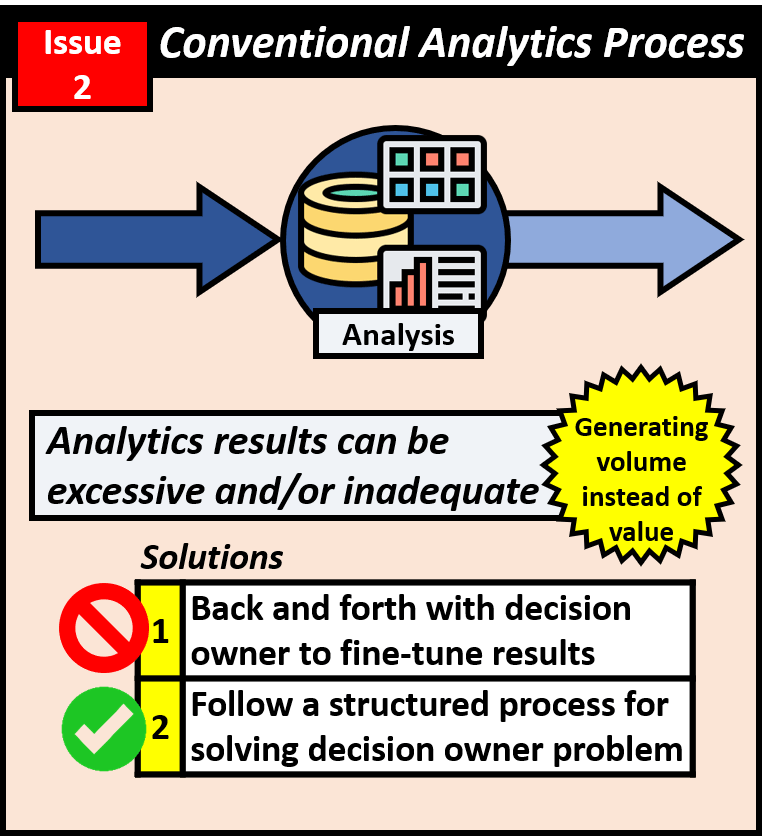
Issue 2 with the conventional analytics process is that analytics results can be excessive and/or inadequate by generating volume instead of value. A bad solution is to go back and forth with the decision owner to fine tune the results whereas a better solution is to follow a structured process for solving the decision owner's problem from the start.
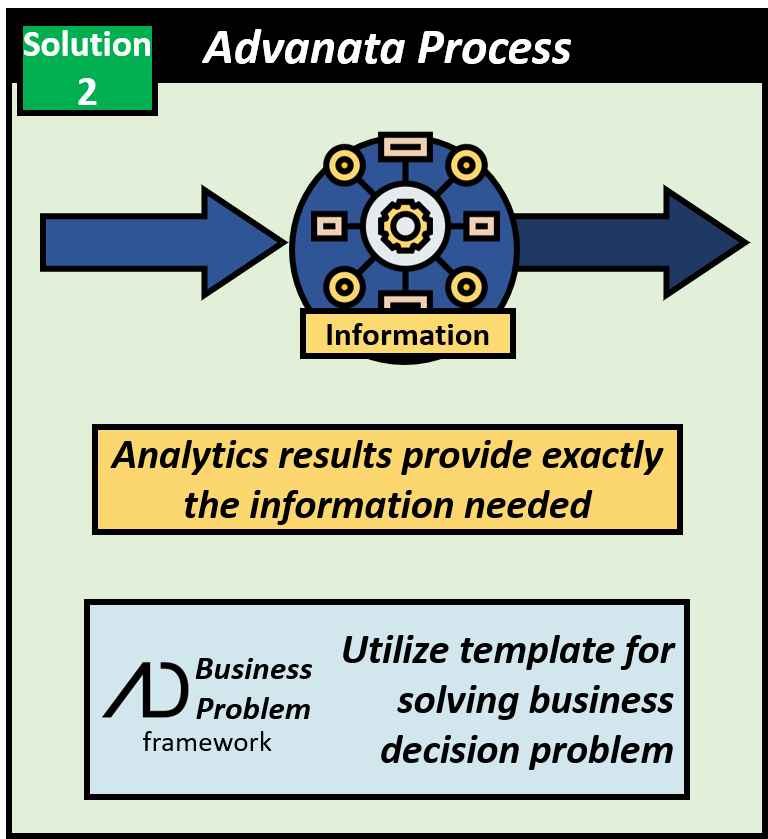
Solution to issue 2 using the Advanata process is to generate the exact information needed rather than analytics results. The business problem framework offers a template for solving business decision problems and defining the exact information needed.

The final step is where conventional approaches really break down. Without precise actions, decision owners must subjectively interpret analytical results to identify potential initiatives. Advanata‘s structured problem framework instead allows for the generation of precise, optimal actions that directly align with the decision problem.
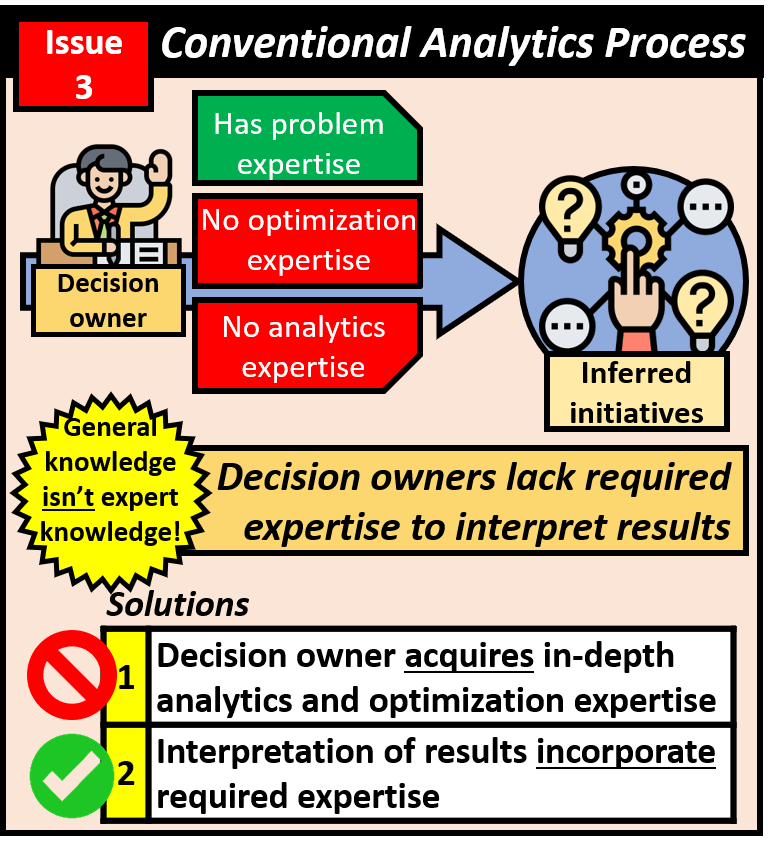
Issue 3 with the conventional analytics process is that the decision owner who has no optimization or analytics expertise is tasked with interpreting analytics results. General knowledge isn't expert knowledge. Bad soltuion is for the decision owner to acquire in depth analytics and optimization expertise while a better solution is to generate results that already incorporate required expertise.
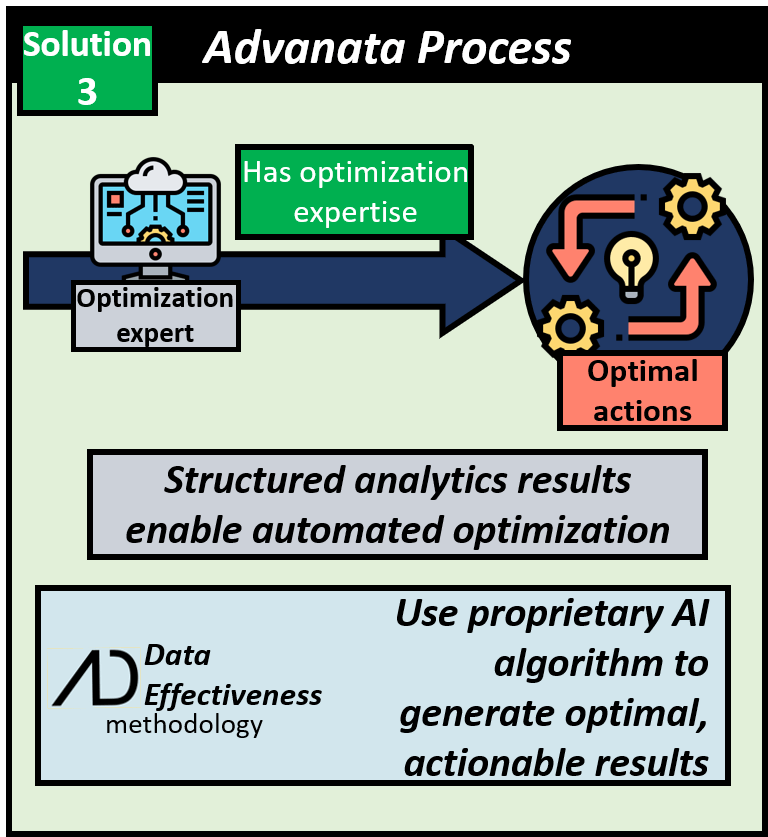
Solution to issue 3 with the Advanata process is to structure analytics results to enable automated optimization using the data effectiveness methodology and generate optimal actionable results.

Comparing Approaches

This is a typical analytics project: a poorly defined problem, extensive data gathering and analysis, and results that the customer must interpret to reach a solution. Advanata starts with a clear problem definition, reducing the scope to the minimum required and enabling rigorous optimization that produces the exact actions needed to solve the problem.
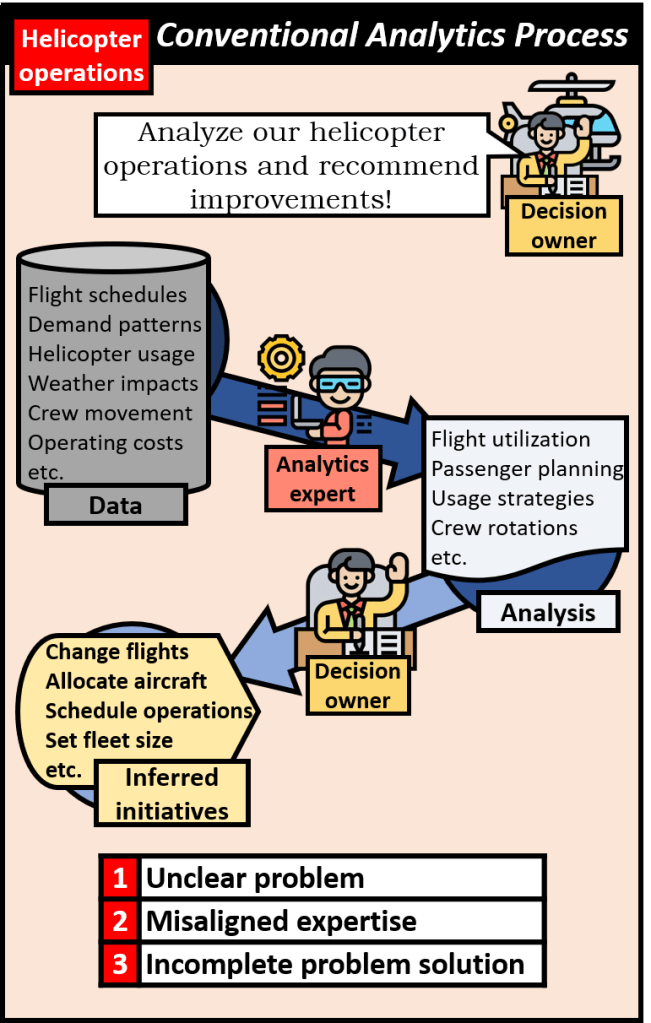
Using the conventional analytics process for a decision owner who wants their helicopter operations analyzed and improvements to be found. This starts with a massive repository of data related to the problem which is processed by the analytics expert into extensive analysis reports which are then processed by the decision owner to inferred initiatives. Problem from the start is unclear, expertise is misaligned in the solution process, and the solution is incomplete.
The same problem solved using the Advanata process starts with a better defined question from the decision owner: how should we allocate our helicopters to maximize profitability while meeting safety and service requirements? A problem limited amount of data along with problem expertise is processed using the inductive approach into specific information defined by the business problem framework which can then be automatically optimized by the data effectiveness methodology into optimal actions. The problem is precisely defined, different expertise is leveraged, and a complete solution is generated.

Importance of Problem Structuring

Analytics and decision science can transform how businesses solve problems, but only with a structured process. A poorly defined approach cannot produce the best solution. Advanata helps customers define and frame their decision problem from the start, enabling analytics experts to maximize their contribution and ensuring the best possible solution is delivered.

One quick poll question (3 seconds):
I’d really value your input.

Sign up for early access to articles, delivered every two weeks. Please check your spam folder for the confirmation email.

Ready to see Advanata in action? Explore more resources, read related articles, and access the full application at advanata.com.

Looking for a personalized walkthrough or decision intelligence consulting? Contact info@advanata.com to get application access, schedule a demo, or discuss your decision optimization challenges.

Leave a comment